





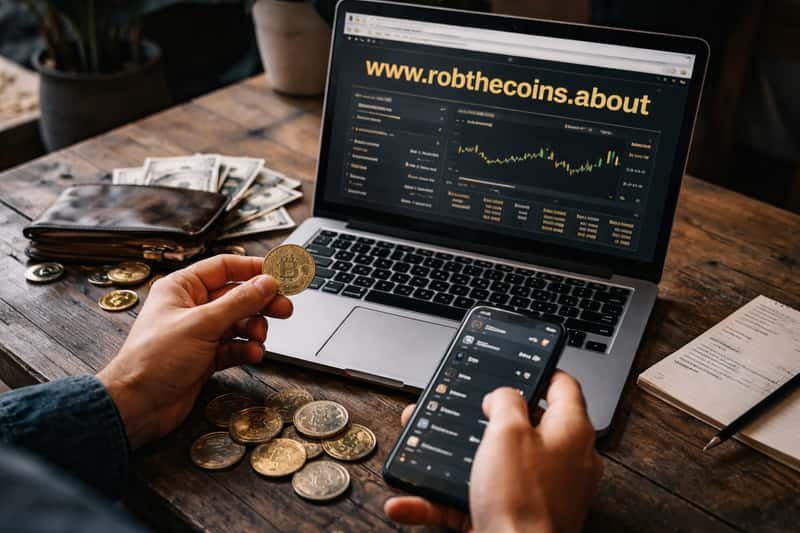
You land on a page that calls RobTheCoins a “next-generation blockchain.” Click a sibling site and it’s a beginner crypto blog where you can’t buy anything. A third review pitches an AI trading bot that “never sleeps.” Here’s the plain-English verdict: RobTheCoins is not one product with one clear identity. It’s a name attached to at least four conflicting descriptions across different domains and reviews, and that inconsistency is the single most useful thing to know before trusting any of it. This piece maps every version, names the people supposedly behind it, and treats the shape-shifting as the red flag it is.
What RobTheCoins Actually Is
RobTheCoins is best understood as a brand name, not a single verified product. Depending on which page you hit, it presents as a crypto exchange, a beginner education blog, a micro-earning rewards hub, or a proprietary blockchain with a native token. Those descriptions do not agree with each other, and no independent source pins the project to one auditable identity.
One third-party crypto review site, GoldZeus (not a regulator or major exchange, just a niche review blog), put it directly: the available information suggests RobTheCoins is “more credibly understood as a platform and content ecosystem rather than a widely recognized, independently documented base-layer blockchain like Ethereum or Solana.” Translation: the grand technical claims live in marketing copy, not in verifiable records. If you came here for a fast verdict, that is it. RobTheCoins is a name wearing several costumes, and none of them come with receipts.
robthecoins.com vs robthecoins.net

Two domains, one brand, two very different pitches. Knowing which site you actually landed on changes what you think RobTheCoins is.
robthecoins.net Is a Content Blog
A July 2026 write-up by blogger Kartik Ahuja clears this up bluntly: RobTheCoins investing is “a content website. Think of it like a crypto explainer blog. You cannot buy, sell, or manage any digital assets through it.” That’s robthecoins.net in one line. It’s articles about DeFi, NFTs, and smart contracts aimed at beginners. No wallet, no trades, no custody. If that’s the page you’re on, the “exchange” and “AI bot” language you read elsewhere does not apply to it.
robthecoins.com Claims Trading and Auctions
robthecoins.com tells a different story. Reviews describe it offering trading, custodial wallets, and market charts for retail traders and developers. Spelwise, another independent review site (again, not a regulator or a recognized financial outlet), framed it as “an ecosystem that blends trading, education, and business tools.” So the .com is the ambitious face, the .net is the blog. Same brand, opposite functions, marketed to the same crypto-curious person. That split is not clarity. It’s confusion with a shared logo.
Mapping Every Face RobTheCoins Presents
Line the versions up side by side and the problem gets obvious fast.
Exchange, Blog, Rewards Hub, or Blockchain
Here’s the map, drawn only from what’s publicly described online.
| Face | What it claims | Where it shows up | Verifiable? |
|---|---|---|---|
| Exchange | Trading, wallets, market data | robthecoins.com reviews | No disclosed regulation or audit |
| Education blog | Beginner crypto explainers, no trading | robthecoins.net | Yes, it’s just content |
| Rewards hub | Airdrops, tasks, referral micro-earnings | Third-party business reviews | No documented payout data |
| Blockchain | RTC token, dApps, “low fees” | Standalone guides | No public on-chain proof |
Four faces, one name, and only the blog is straightforwardly what it claims to be.
Why the Conflicting Descriptions Matter
A regulated exchange has one identity you can check against a license. A blog is a blog. RobTheCoins is described as both plus a rewards app plus a blockchain, and that means there is no fixed thing to hold accountable. Regulators have warned for years that unregulated crypto platforms leave consumers exposed, and the ESMA consumer advisory on cryptoassets lays out exactly why opaque, shape-shifting operations are hard to assess for safety. When the identity moves, so does the risk you can never quite measure.
Who Runs RobTheCoins? The Founder Question
Every legitimacy check starts with a simple question: who is actually behind this?
What Little Is Verifiable About Fyona Menas and Reg Payton
Multiple review sites, including TechShali and GoldZeus (both small third-party tech and crypto blogs, not independent registries or regulators), credit RobTheCoins to two crypto enthusiasts, Fyona Menas and Reg Payton, with a stated mission to demystify DeFi, NFTs, and smart contracts. The names repeat across coverage. What doesn’t show up is independent confirmation: no verifiable professional history, no prior documented projects, no regulatory standing tied to either person in public records.
Names in an “About” page are not credentials. As one of those review sites, TechShali, put it, an About page “explains what the company claims to be, but it doesn’t prove regulation or security. Always double-check.” Two names with almost no traceable background is not a founding team you can vet. It’s a byline. If you’re weighing whether to trust this alongside other obscure sites, the same skepticism applies to a domain like the one covered in our is zingyzon.com legit breakdown, where the operator trail also runs thin.
The RTC Token and AI Trading Bot Claims
The two most exciting-sounding features are also the two with the least proof.
The RTC Blockchain Narrative
One guide describes a RobTheCoins blockchain with a native RTC utility token, pitched as a scalable, low-fee distributed ledger that powers dApps and pays for transaction “gas.” It reads like a real chain. The trouble is that public technical documentation is thin to nonexistent. There’s no widely indexed block explorer, no independently verified on-chain activity, no code repository review cited anywhere credible. A distributed ledger you can’t inspect is a claim, not a network. Put simply, promises about a decentralized system mean nothing when there’s no verifiable infrastructure you can actually check behind them.
The “Never Sleeps” AI Trading Bot
A robthecoins.com review markets an “AI-powered crypto trading bot that never sleeps,” describing an automated system that spots price changes and generates passive income with minimal user effort. Passive income and algorithmic trading are the oldest hooks in crypto marketing. No performance audit, no documented returns, no independent test backs the bot claim. It exists in the platform’s own copy and friendly third-party reviews, which is marketing, not evidence.
Is RobTheCoins Legit? The Due-Diligence Check
Asking is RobTheCoins legit is the right instinct. Here’s the evidence-based answer.
No Disclosed Regulation, Audit, or On-Chain Proof
A comparison against major exchanges published by Bitget Academy (the education arm of the Bitget exchange, so a crypto-industry source rather than a neutral regulator) flagged RobTheCoins for limited asset selection, an undisclosed fee structure, and unclear regulatory status, with no comprehensive security documentation. Stack that up: no disclosed license, no published audit, no verifiable on-chain data, no transparent account of how user funds or data are handled. You cannot confirm it’s a scam from public info alone, and you also cannot confirm it’s safe. Absence of proof is not proof of safety. For a platform that touches money, unverifiable is a verdict.
How to Vet Any Site Like This Yourself
Run this on RobTheCoins or any site making similar promises:
- Search for a regulator license number and confirm it on the regulator’s own database. RobTheCoins discloses none.
- Find a named, independently verifiable founder with a real track record. Two thin bios do not clear this bar.
- Look for a third-party security audit, not a self-published claim. None is public here.
- Check for real on-chain activity in an independent explorer. There isn’t verifiable data to check.
Four checks, four blanks. That pattern is the answer.
Why the Shifting Identity Is the Real Red Flag
The strongest warning here isn’t any single missing document. It’s the shape.
Ambiguity as a Marketing Feature, Not an Accident
A platform that reads as an exchange to traders, a free blog to beginners, and a rewards app to task-earners can pitch three audiences at once without fully delivering on any single promise. That flexibility is convenient for whoever runs it and terrible for whoever uses it, because there’s no fixed identity to hold responsible when something goes wrong. The inconsistency isn’t sloppy branding you should forgive. It’s the mechanism. When a project can be whatever the current visitor wants, accountability has nowhere to attach.
The Bottom Line
RobTheCoins isn’t clearly a scam and it isn’t clearly safe, and that gray zone is the whole story. A brand that can’t hold one identity across two domains hasn’t earned the benefit of the doubt with your money. Read the blog if you want free crypto explainers. Treat every trading, token, and bot claim as marketing until an audit, a license, or real on-chain data says otherwise.
FAQs about RobTheCoins
Is RobTheCoins legit or a scam?
Public information can’t confirm either. There’s no disclosed regulation, no security audit, and no verifiable on-chain data, so the honest verdict is unverifiable, which is a reason for caution with any funds.
What’s the difference between robthecoins.com and robthecoins.net?
robthecoins.net is a content-only blog where you cannot trade or hold assets. robthecoins.com claims trading tools, wallets, and market data. Same brand name, two different functions.
Who are the RobTheCoins founders?
Sources name Fyona Menas and Reg Payton as founders with a mission to demystify crypto. Independent proof of their credentials, prior projects, or regulatory standing does not appear in public records.
Is the RTC token real and worth buying?
The RTC token is described in the platform’s own materials as a blockchain utility token, but there’s no verifiable on-chain data or independent audit backing it. Treat it as a claim, not a confirmed asset.
How does RobTheCoins compare to Binance or Coinbase?
A 2026 comparison flagged RobTheCoins for limited assets, opaque fees, and unclear regulatory status, unlike major exchanges that publish licensing and security documentation. The gap in transparency is significant.