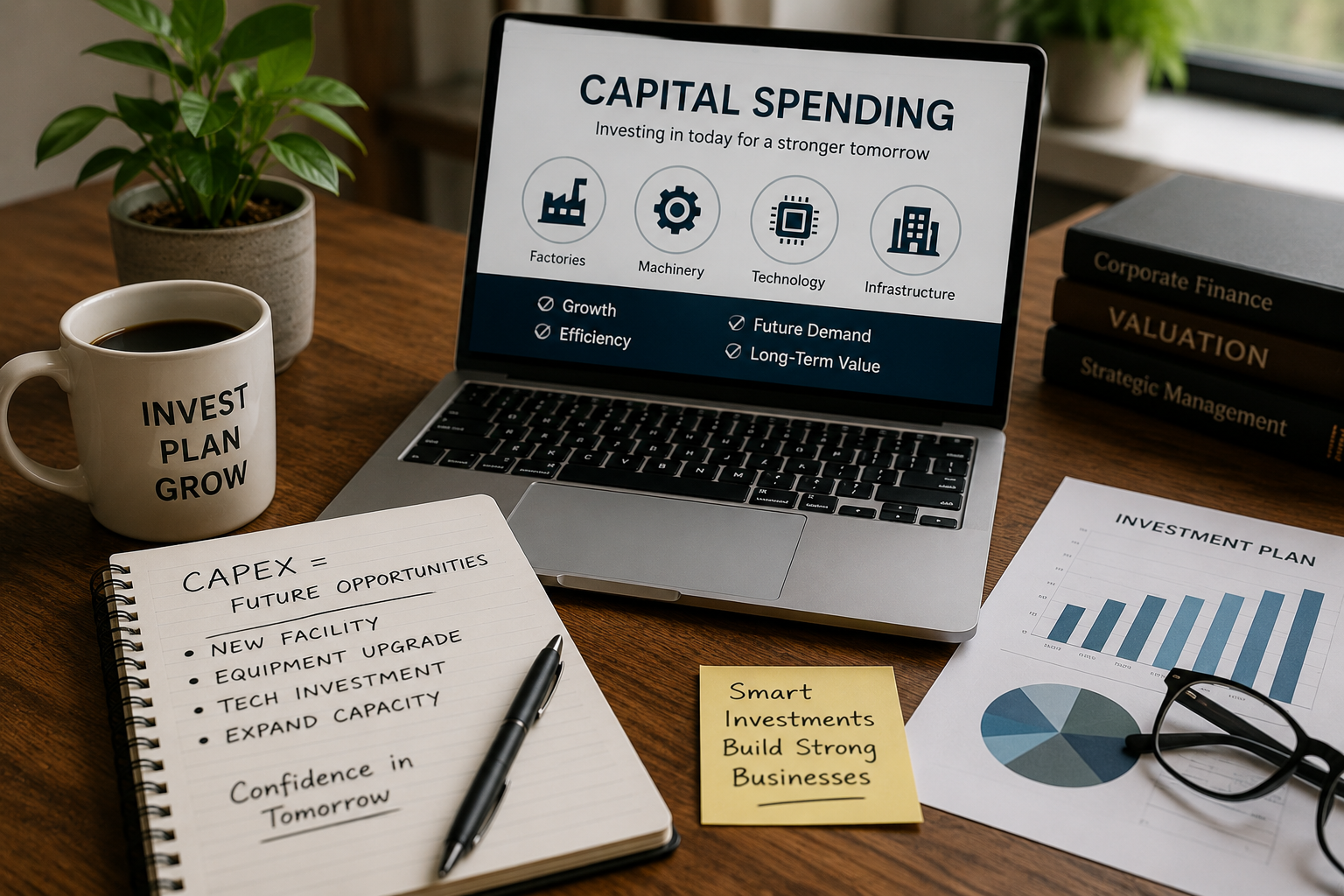
A company’s spending plans can sometimes reveal more than its public statements. Kavan Choksi draws attention to capital expenditure, or capex, because decisions to commit money to factories, machinery, technology and infrastructure are rarely made without a view of where demand may be heading. When businesses are willing to invest heavily in the future, that can offer useful clues about confidence, priorities and the direction of an industry.
Imagine two companies in the same sector. Both report respectable profits, both speak positively about the year ahead, and both say they expect demand to remain healthy. One, however, is increasing spending on new facilities and equipment. The other is cutting investment and preserving cash.
Those companies may be telling very different stories.
Capital expenditure is where optimism becomes expensive. Expanding a factory, building a data center or purchasing a fleet of new vehicles can require commitments that take years to recover. Management teams therefore tend to think carefully before approving major projects. That makes capex an interesting window into what businesses actually expectrather than simply what they say.
Spending With a Purpose
Not all capital expenditure is about growth.
Some spending is unavoidable. Machinery wears out. Buildings need maintenance. Computer systems become obsolete. A company replacing equipment simply to maintain current operations is doing something very different from a business spending aggressively to double production capacity.
This distinction matters.
Maintenance capex helps preserve what already exists. Growth capex is intended to create something more: additional output, new customers, lower costs or entry into another market.
A manufacturer adding a second production line may be expecting demand to rise. A retailer investing in distribution centers could be preparing for increased online sales. A technology company building more computing capacity may be positioning itself for greater use of artificial intelligence or cloud services.
The headline number can therefore tell only part of the story. Where the money is going is often more informative.
Following the Money Across Industries
Capital spending can also reveal which industries believe structural changes are underway.
Take the enormous sums being committed to data centers, semiconductor manufacturing and power infrastructure. Those projects reflect an expectation that demand for computing capacity will remain substantial. Whether every investment ultimately generates an attractive return is another question, but the scale of spending itself says something about corporate expectations.
Energy provides another example. Investment decisions in oil, gas, renewables and electricity networks can stretch over decades. Companies must estimate future prices, regulation and demand long before a project begins generating revenue.
The same is true in transportation, manufacturing and telecommunications.
This is why changes in capex can sometimes identify economic shifts before they become obvious to consumers. New factories, warehouses and networks are usually planned because somebody expects them to be needed later.
The Cost of Capital Changes Everything
There is, however, a practical obstacle to almost every ambitious investment project: financing.
When interest rates are low, companies can justify a wider range of projects. If borrowing becomes considerably more expensive, management may revisit the numbers.
Suppose a planned facility is expected to generate a modest but reliable return. At a low financing cost, the economics might look attractive. Raise that cost substantially and the same project may no longer make sense.
This is one reason higher interest rates can influence the economy with a delay.
A company does not necessarily cancel an investment project the day a central bank raises rates. Existing plans may continue, financing may already be secured and executives may wait to see whether conditions change. Over time, however, fewer new projects can be approved.
The result may eventually appear in lower equipment orders, weaker construction activity or slower hiring.
Capital expenditure can therefore act as one of the channels through which monetary policy reaches the real economy.
When Less Spending Is Not Necessarily Bad
Falling capex can sound alarming, but context matters here too.
A company may reduce capital spending because a major expansion program has just finished. It might discover that new technology allows it to operate with fewer physical assets. Management could also decide that returning cash to shareholders is more attractive than investing in projects offering poor returns.
Spending more is not automatically a sign of good management.
History contains plenty of examples of companies investing enthusiastically at the top of a cycle, only to discover that they had built too much capacity. Airlines, energy producers, property developers and semiconductor companies have all experienced periods where rapid expansion was followed by excess supply.
In those circumstances, disciplined spending can be a strength.
The key question is whether management is investing because attractive opportunities genuinely exist or because competitors are doing the same thing and nobody wants to be left behind.
That distinction is particularly relevant during investment booms.
The Supplier Effect
Large capital projects rarely affect only the company paying for them.
A new factory might require construction firms, engineering consultants, machinery manufacturers, software providers and transportation companies. Once operational, it may require additional employees and generate demand for suppliers.
Capital expenditure therefore creates chains of economic activity.
If several large industries begin investing simultaneously, those effects can spread surprisingly far. Strong demand for specialized equipment can benefit manufacturers. Construction projects can increase demand for labor and raw materials. Technology spending can support an entire network of vendors.
The reverse is also true.
When businesses collectively become cautious, suppliers can feel the slowdown before consumers do. Orders are postponed, projects are delayed and contractors find their pipelines becoming thinner.
Watching capital spending can therefore provide insight into more than the companies making the original investment.
A Clue, Not a Crystal Ball
Investors should be careful not to treat rising capex as a guaranteed signal of future success.
Spending money is easy. Earning an attractive return on that money is harder.
The most useful analysis asks what a company is spending on, why the investment is necessary and what return management expects it to generate. It also helps to consider whether competitors are expanding at the same time and whether the industry could eventually face excess capacity.
This is where capital expenditure becomes more interesting than a simple accounting line.
It represents management making a tangible commitment to a particular version of the future.
A company can change its marketing message overnight. It can revise an earnings forecast in a quarter. A multibillion-dollar factory is harder to reverse.
That is why capital spending deserves attention. It may not predict exactly what happens next, but it can reveal which businesses are preparing for growth, which industries expect demand to expand, and where corporate confidence is strong enough for companies to put serious money behind it.