Sustainable practices in farm maintenance are essential not just for preserving the land, but also for improving long-term farm productivity. Modern agriculture increasingly seeks to pair profitability with practices that protect and enhance the environment. Whether you run a large operation or a family farm, integrating eco-friendly solutions can yield significant benefits. One foundational step toward this is securing land boundaries with a reputable fence manufacturer to ensure responsible, durable farm infrastructure.
Adopting sustainable farm maintenance benefits crops, livestock, water, soil, and rural communities. Thoughtful land management, equipment, and resource choices help secure farms and the environment for future generations. This article covers approaches from orchard management to water-use and recharge projects, supporting environmental and economic goals with research and real-world examples. Holistic methods promote healthier soils, cleaner water, and resilient agriculture amid climate and market challenges.
Integrated Orchard Management
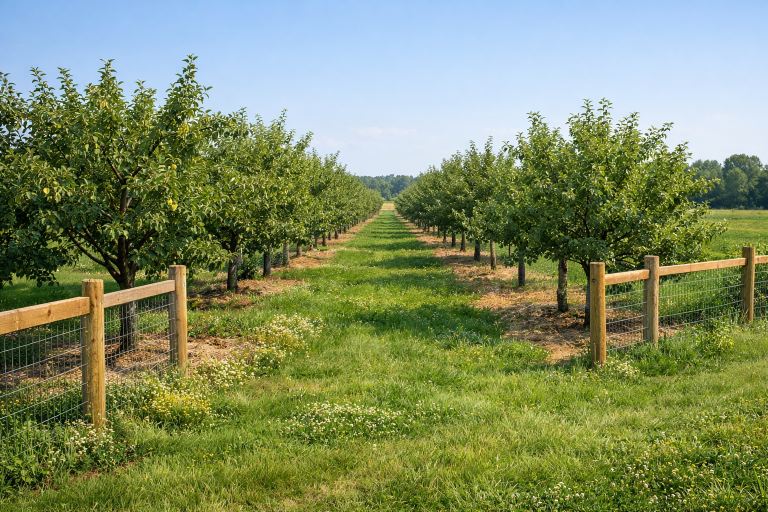
Integrated Orchard Management (IOM) is an advanced approach that combines various best practices to maintain orchard health while minimizing negative environmental impact. These practices reduce soil erosion and maximize nutrient retention, which is especially important for permanent crops like nuts and fruits. According to a study of Australian macadamia orchards, adopting IOM reduced surface runoff by about 70%. These results underscore how improved ground cover management and diversified orchard plantings support soil structure and water conservation. Research on IOM supports its role as a core element of regenerative agriculture, promoting resilience and reducing the penetration of fertilizers and pesticides into waterways.
Sustainable Crop Rotation
Diverse crop rotation is fundamental to soil health and nutrient management. Moving beyond the conventional two-year corn-soybean rotation, research supports the inclusion of cereal rye, winter wheat, and cover crops in extended rotations. Studies have shown that such diversification significantly decreases soil nitrate loss without hurting crop yields. These approaches also disrupt weed and pest cycles, further reducing the need for chemical herbicides while enhancing soil organic matter. In the Midwest, adoption of three-year (or longer) rotations has been linked to improved overall farm resilience and reduced contamination of local waterways.
Autonomous Electric Mowing
Transitioning to autonomous electric mowing technology offers a win-win for efficiency and sustainability. Battery-powered machines, such as the FireFly Automatix AMP-L100, are increasingly used for both sports turf and agricultural settings. These fully autonomous, all-electric mowers produce less noise, zero direct emissions, and reduced labor requirements compared to standard fossil-fuel-powered mowers. Not only do they minimize the carbon footprint associated with maintenance, but they can also maintain large acreages with precision and consistency, ultimately supporting improved turf and soil health.
Utilizing Wastewater for Plant-Based Feed and Fertilizer
An innovative method in regenerative agriculture is converting wastewater into plant-based feed and fertilizer. Agricultural startups are pioneering closed-loop systems that use nutrient-rich wastewater to grow aquatic plants. These plants can be used to produce sustainable animal feed or processed into natural fertilizers, reducing reliance on synthetic products. The environmental impact is twofold: wastewater from various sources is recycled, and nutrient pollution in local waterways is reduced. Such techniques democratize access to affordable, sustainable farm inputs and align with circular economy principles.
Conservation-Focused Farming Practices
Farmers adopting conservation-focused improvements have seen marked benefits in both environmental health and productivity. Techniques such as grassed waterways, rotational grazing, cover cropping, and reduced tillage are central components of conservation farming. These practices help retain topsoil, safeguard freshwater quality, and boost soil microbial diversity. Real-world transformations, like those reported by Amish farmers in Pennsylvania, show that a mix of traditional knowledge and modern best practices can lead to thriving, sustainable farmland.
Using Livestock for Vegetation Management
Integrating livestock such as goats and sheep for targeted grazing is a sustainable alternative to mechanical or chemical vegetation control. Targeted grazing with livestock effectively manages invasive species, reduces fire fuel loads, and naturally fertilizes the soil. Municipalities and private landowners have embraced these strategies as a cost-effective and environmentally preferred method for brush and weed control. Grazing strategies offer ecological benefits by recycling nutrients and enhancing biodiversity, especially in marginal or difficult-to-mow areas.
On-Farm Recharge Projects
On-farm recharge projects address the urgent need to replenish groundwater. By directing surplus surface water during wet seasons onto farmland, water infiltrates and replenishes depleted aquifers. Recent pilot programs in California’s San Joaquin Valley evaluate water recharge on orchards, merging soil health initiatives with water management. These projects aim to stabilize regional water supplies, support crops during drought, and create an adaptive buffer for climate-resilient agriculture.
Conclusion
Embracing sustainable farm maintenance transforms agriculture from a resource-intensive industry into a pathway for regeneration and stewardship. Through integrated orchard management, diversified crop rotations, autonomous electric mowing, wastewater reuse, conservation initiatives, livestock vegetation management, and groundwater recharge, farmers can improve their yields, reduce environmental impact, and secure long-term profitability. Now is the time for farmers, policymakers, and consumers to adopt and support practices that foster both productivity and ecological balance for future generations.