If you copy someone else’s syringe unit number off a group chat and you can end up drawing double the peptide you meant to, same vial, same milligrams, wrong water. That gap is exactly what a Retatrutide dosage calculator exists to close. The core math is simple: units to draw equals (target dose mg divided by total vial mg) times the total units of reconstitution water in the syringe. What most people miss is that these tools are not clinical dosing engines. A Retatrutide dosage calculator converts vial size and dilution volume into a syringe unit count for a dose you already picked, and nothing about that math tells you whether the dose is safe or right for you.
What a Retatrutide Dosage Calculator Actually Does
Units to draw equals (target dose mg divided by total vial mg) times the total units of water in the syringe. That single line is the whole engine behind a Retatrutide dosage calculator. It takes your vial strength, the water you added, and the dose you chose, then spits out a number of syringe units.
That’s the ceiling of what it does. It converts vial size and water volume into a syringe unit count, full stop. The output is one number: how many marks to draw to on the barrel. It does not decide your dose, check your health, or verify that the peptide in your vial matches the label.
The Investigational Status You Need to Know First
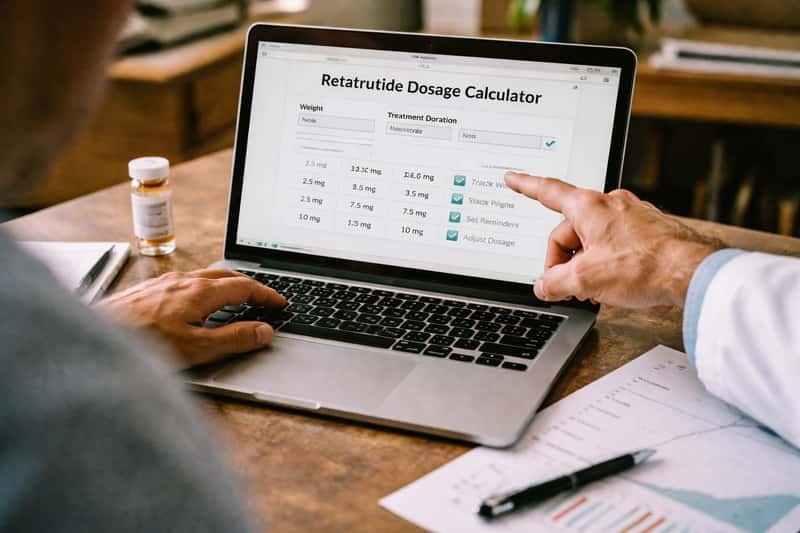
Retatrutide is not FDA-approved. It’s sold as a research chemical, not a consumer weight-loss product, and any math on this page is arithmetic, not medical advice. No dose here is recommended or endorsed.
Why “Research Use” Framing Changes Everything
Most vendor calculator pages quietly skip the part where no approved dose exists. The FDA’s drug development process still classifies retatrutide as investigational, which means every dosing figure floating around comes from early-stage trials, not a prescribing label. Read those numbers as research data, not a prescription written for you.
The Three Inputs Every Calculator Needs
A calculator is only as accurate as what you feed it. Garbage in, confident-looking garbage out. Every tool asks for the same core variables:
- Vial strength in mg (commonly 10mg, 20mg, or 30mg)
- Bacteriostatic water added, in mL
- Syringe type, almost always U-100
- Target dose in mg
Get one of these wrong and every number downstream is wrong too. The vial strength and water volume set your concentration. The syringe type sets how the draw volume gets read. The target dose is the only input that’s genuinely a choice, and it’s the one the math can’t make for you.
Vial Size and Doses Per Vial
Vial strength sets your total supply. Doses per vial equals total mg divided by target dose, so a 10mg vial at 2mg per dose gives you five doses. A 30mg vial at the same 2mg dose stretches to fifteen. Bigger vial, more shots, same math.
Why the Syringe Type Matters
U-100 syringes read in units where 100 units equals 1 mL. That’s the conversion backbone the whole tool leans on. If you plug in a syringe that isn’t U-100, or misread the scale, every unit figure the calculator gives you is off by a fixed multiple. This is the quiet source of a lot of dosing errors.
The Reconstitution Math, Step by Step
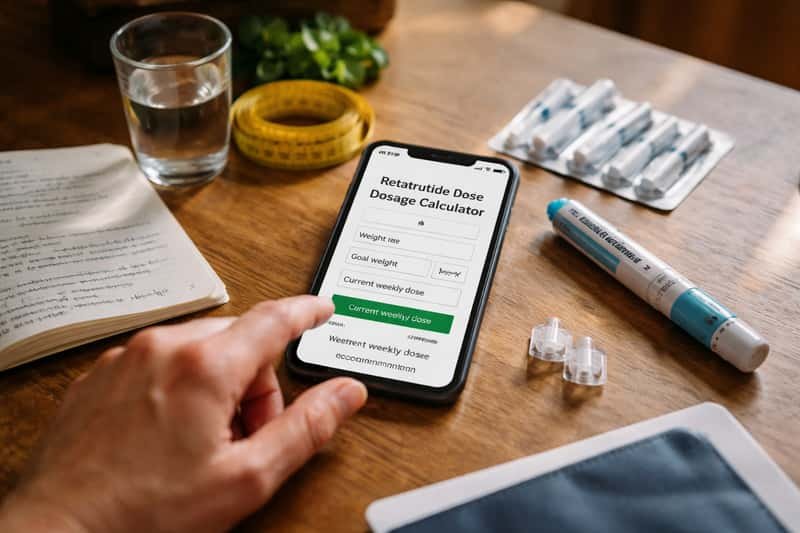
Run the calc in this order and it stays clean:
- Concentration = vial mg divided by water mL
- Draw volume = dose mg divided by concentration
- Units = draw volume mL times 100
Three steps, no shortcuts. A retatrutide reconstitution calculator is just automating these three lines. The MedlinePlus explainer on units, concentrations, and dilutions covers the same principle any pharmacy tech uses, and the peptide version is no different.
Concentration Comes First
Concentration in mg/mL is total peptide divided by the water you added. This one number drives every unit count that follows. Change the water, change the concentration, change every downstream figure. It’s the hinge the whole calculation swings on.
A Fully Worked Example
Take a 10mg vial reconstituted with 2mL of bacteriostatic water. Concentration is 10 divided by 2, so 5 mg/mL. For a 2mg dose, draw volume is 2 divided by 5, which is 0.4 mL. Convert to units by multiplying by 100, and you get 40 units on a U-100 syringe. Every step visible, no black box.
Same Dose, Less Water
Now redo that exact 2mg dose with only 1mL of water. Concentration jumps to 10 mg/mL. Draw volume drops to 0.2 mL. The syringe now reads 20 units. Same 2mg dose, half the units on the barrel.
Why Dilution Volume Moves the Units
Here’s the insight the vendor pages bury: the syringe unit count is not the dose. It’s a function of how much water you added. Two people injecting the identical 2mg can draw to wildly different unit marks, one at 20 and one at 40, and both are correct for their own vial. This is why lifting someone else’s unit number off a forum is a real mistake. Their water isn’t your water.
| Vial | BAC water | Concentration | 2mg draw | U-100 units |
|---|---|---|---|---|
| 10mg | 1 mL | 10 mg/mL | 0.2 mL | 20 units |
| 10mg | 2 mL | 5 mg/mL | 0.4 mL | 40 units |
| 10mg | 3 mL | 3.33 mg/mL | 0.6 mL | 60 units |
Syringe Accuracy Limits at Low Draw Volumes
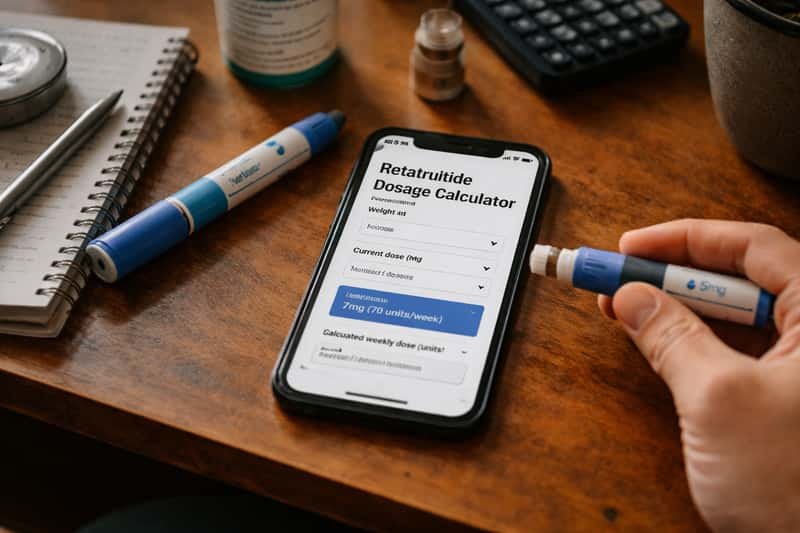
Very small draws are hard to measure precisely. A 0.1 mL draw on a standard 1mL insulin syringe leaves you eyeballing a sliver of the barrel, and a small hand-eye slip turns into a large percentage error. Miss by 0.02 mL on a 0.1 mL target and you’re off by 20 percent.
When a Smaller Syringe Helps
A 0.3 mL insulin syringe gives finer gradations, so tiny doses read more accurately at low volume. Adding more bacteriostatic water is the other lever: more water pushes the draw volume up into a range your eyes and hands can actually hit. The mg to units conversion doesn’t change, but your margin for error shrinks.
Why Titration Figures Circulate Online
Search retatrutide and you’ll trip over a stepwise dosing ladder posted in forums and vendor pages as if it were a schedule. Those figures trace back to how phase 2 trials structured their dose-escalation arms, where participants moved up in stages under supervision. The numbers spread because they’re the only concrete data points people can point to, not because anyone published them as instructions.
Why a Copied Chart Isn’t a Schedule
A titration figure lifted off a chart is a research data point stripped of its trial context: the monitoring, the eligibility screening, the medical oversight that surrounded it. A calculator doesn’t pick a starting figure or a ceiling for you. It only converts whatever mg you type into units, which is a very different thing from telling you what to type.
“How Many Units” vs “What Dose” Are Two Different Questions
This is the gap most pages ignore. A calculator answers exactly one question: how many units do I draw for a dose I already picked. It has nothing to say about what dose you should take, which carries real safety weight and belongs with a medical professional. Keep the two questions in separate boxes. The math tool handles the arithmetic. A clinician handles the decision. The arithmetic is honest, and the dose decision is not the calculator’s job.
FAQs about Retatrutide dosage calculator
How do you convert mg to units for retatrutide?
Find concentration first (vial mg divided by water mL), then divide your dose in mg by that concentration to get draw volume in mL, then multiply by 100 for U-100 units.
How many units is 2mg of retatrutide?
It depends entirely on your dilution. A 10mg vial with 2mL water makes 2mg read as 40 units, but the same 10mg vial with 1mL water makes 2mg read as 20 units.
Is retatrutide FDA-approved?
No. Retatrutide is investigational and sold as a research chemical, not an approved consumer weight-loss product, so any dosing figures are research data rather than a prescription.
How much bacteriostatic water should I add to a vial?
The calculator doesn’t require a specific amount, but the volume you choose sets your concentration and changes every unit count. More water raises draw volume and can improve low-dose accuracy.
What syringe is best for a retatrutide dosage calculator in units?
U-100 insulin syringes are standard, where 100 units equals 1 mL. A 0.3 mL syringe gives finer gradations for very small doses and improves read accuracy at low volumes.
How many doses per vial will a 10mg vial give?
Doses per vial equals total mg divided by target dose. A 10mg vial at 2mg per dose yields five doses. A 30mg vial at the same dose yields fifteen.
Does a Retatrutide dosage calculator for weight loss recommend a dose?
No. It only converts a dose you’ve already chosen into syringe units. It does not decide what dose is appropriate, which is a medical question, not a math one.
How long does reconstituted retatrutide last once mixed?
Shelf life once mixed depends on storage, but reconstituted peptides are generally kept refrigerated, not left at room temperature. Follow the storage guidance on your specific vial, since a calculator has nothing to say about how long the mixed solution stays stable.
Why do so many titration figures show up in retatrutide forums?
Those figures come from how phase 2 trials structured their dose-escalation arms. They circulate because they’re the only concrete numbers available, not because anyone published them as a schedule to copy.
Why does my calculated draw volume seem too small to measure?
Very low draw volumes near 0.1 mL are hard to read on a 1mL syringe. Use a 0.3 mL syringe for finer marks, or add more water to push the draw volume higher.
Retatrutide Dosage Calculator
Convert a clinician-provided dose between milligrams, milliliters, and U-100 syringe units, and calculate weight-loss progress. This tool does not determine what dose you should take.
Retatrutide dosage calculator in units
Direct concentration calculator
Retatrutide calculator for weight loss
Percentage weight-loss calculator
Retatrutide dosage calculator — female
There is no automatic “female dose” built into this calculator. Sex by itself should not be used to generate a medication dose. This section combines the same clinician-provided dose conversion with optional weight-progress information.
How the conversion works
The calculator does not decide a retatrutide dose. It only performs arithmetic after you provide both the intended dose and the exact concentration.
Vial concentration
Injection volume
Syringe units
U-40 units = volume (mL) × 40
“Units” are syringe-volume markings, not milligrams. A unit value is meaningless without knowing the concentration and syringe type.
Why no recommended dosing schedule?
As of August 2026, retatrutide is still an investigational medicine. Clinical-trial regimens are research protocols, not self-treatment instructions.
Retatrutide Dosage Calculator
Convert a clinician-provided dose between milligrams, milliliters, and U-100 syringe units, and calculate weight-loss progress. This tool does not determine what dose you should take.
Retatrutide dosage calculator in units
Result
Direct concentration calculator
Retatrutide calculator for weight loss
Percentage weight-loss calculator
Retatrutide dosage calculator — female
There is no automatic “female dose” built into this calculator. Sex by itself should not be used to generate a medication dose. This section combines the same clinician-provided dose conversion with optional weight-progress information.
How the conversion works
The calculator does not decide a retatrutide dose. It only performs arithmetic after you provide both the intended dose and the exact concentration.
Vial concentration
Injection volume
Syringe units
U-40 units = volume (mL) × 40
“Units” are syringe-volume markings, not milligrams. A unit value is meaningless without knowing the concentration and syringe type.
Why no recommended dosing schedule?
As of August 2026, retatrutide is still an investigational medicine. Clinical-trial regimens are research protocols, not self-treatment instructions.