



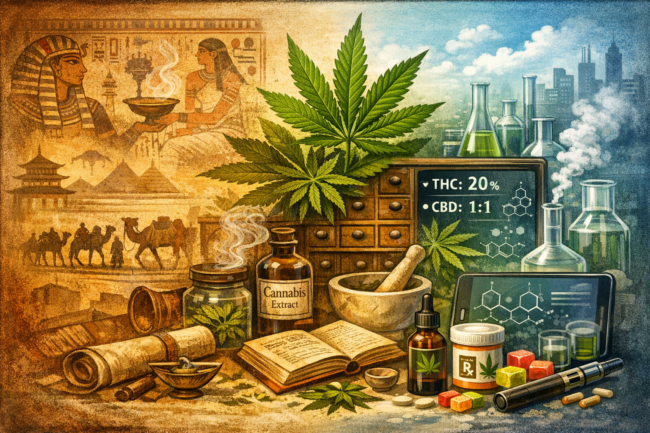
Long before cannabis became a political football or a branded product category, it was treated as a practical remedy in many places. Over centuries and across continents, it appeared in temples and along trade routes, in royal pharmacies and household medicine cabinets—sometimes respected, sometimes distrusted. That long arc matters today not because the past deserves romanticizing, but because it explains a modern reality: cannabis use has always been shaped by context—the culture around it, the intention behind it, and the way it’s prepared.
If you’ve ever looked at a dispensary menu and felt like you were reading a chemistry textbook—THC percentages, CBD numbers, ratios like 1:1 or 20:1, words like “terpenes” and “full spectrum”—you’re not alone. The contemporary market is a fast-moving blend of old ideas and new technology. And yet, in a strange way, the modern obsession with ratios and targeted effects is a return to something ancient: the attempt to match a preparation to a purpose.
This is a history story, but it’s also a “how did we get here?” story.
A plant that traveled with people
Cannabis is one of those plants that refuses to stay in a single chapter of human history. It’s not just “a drug” or “a medicine” or “a fiber crop.” It has been all of those at different times—sometimes simultaneously.
For much of the ancient world, cannabis was part of everyday life in practical ways. Hemp fiber was valuable: tough, versatile, and suited for rope, cloth, and later paper. That matters because “useful plants” tend to spread. Trade routes don’t only carry spices and metals; they carry seeds, techniques, and habits.
As cannabis spread, different regions emphasized different qualities of the plant. Some cultures focused on fiber and seed oil. Others explored the resinous flowering tops for psychoactive or therapeutic effects. The point isn’t that every society used cannabis the same way—it’s that cannabis adapted to what people needed and what local traditions encouraged.
Early medicine, before modern medicine
When we talk about ancient medicine, we’re not talking about randomized controlled trials. We’re talking about systems of knowledge that mixed observation with cosmology, and remedies that were judged by lived experience. In that world, cannabis appeared in various medical traditions as a plant associated with pain relief, sleep, appetite, digestion, and mood—categories that sound familiar because the human body has always had the same basic problems.
It’s tempting to flatten all of this into a single line—“people used it for everything”—but ancient medical systems were rarely that simple. Remedies were often about balance and constitution. A plant wasn’t “good” in the abstract; it was “appropriate” for a certain person, in a certain situation, prepared in a certain way.
That mindset echoes today when consumers talk about “finding what works” and when product makers try to build formulas for specific outcomes. The vocabulary has changed. The underlying impulse hasn’t.
This is where a modern reader can connect the past to the present: the same plant can feel calming to one person and edgy to another, soothing at one dose and overwhelming at a higher one. That variability is not a new discovery—it’s simply that we now have more precise ways to measure and label what we’re taking.
From folk remedy to pharmacy curiosity
In the 19th century, cannabis begins showing up in Western medical contexts more visibly, not as a newly “discovered” plant, but as a plant newly cataloged by expanding empires and global trade. Doctors and pharmacists experimented with cannabis extracts and tinctures. Some found them useful. Others found them inconsistent.
And inconsistency is the villain of early modern pharmacology.
Plant medicines can vary wildly depending on genetics, growing conditions, harvest time, storage, and extraction technique. Without standardization, a “dose” is more like a suggestion. One bottle of tincture might be mild; the next might be strong. That unpredictability, combined with shifting social attitudes and the rise of other pharmaceutical options, made cannabis a complicated fit for medicine that increasingly wanted clean labels and repeatable effects.
So cannabis sat in an awkward middle space: known, used, debated, and gradually pushed toward the margins by forces that had as much to do with politics and economics as they did with pharmacology.
Prohibition: when a plant becomes a symbol
The 20th century turned cannabis into a symbol—of deviance, rebellion, fear, liberation, and identity, depending on who was talking. Prohibition did something important and often overlooked: it didn’t erase use; it changed the ecosystem of use.
When legal markets disappear, a plant stops being “a plant” and becomes “a product” shaped by risk. Potency can rise because stronger products are easier to transport and sell discreetly. Quality control vanishes. Knowledge fragments into subcultures. People learn from rumor and experience rather than labeling and regulated testing. And medical exploration becomes harder, slower, and more politicized.
This is one reason the modern legal era feels so chaotic. We’re not simply “bringing back” cannabis. We’re rebuilding an entire cultural and scientific infrastructure around it—education, dosage norms, consumer language, and the concept of intentional, guided use.
The modern era: legalization meets consumer engineering
Fast forward to the present and cannabis is, in many places, a regulated industry with labs, branding, product categories, and a dizzying level of choice. The plant is the same. Everything around it is different.
In the legal market, cannabis is often experienced through products that would look alien to most historical users: precisely dosed edibles, vape cartridges with targeted cannabinoid profiles, tinctures designed for fast onset, and beverages meant to replace a cocktail.
This is where the “ratio” conversation enters. Modern consumers don’t just ask “Is it strong?” They ask “What’s the balance?” “How does it feel?” “Can I sleep on it?” “Will it calm me without knocking me out?”
That shift is significant. It’s a move away from cannabis as a single blunt instrument and toward cannabis as a toolbox—where the choice of tool matters as much as the material.
If you’re building content that speaks to sleep, anxiety, focus, or recovery, you’re essentially participating in a long historical tradition: treating cannabis not as a monolith, but as a spectrum of effects that can be shaped by preparation and dosage. A modern guide on ratios is part of that lineage, and a useful bridge between ancient intuition and contemporary measurement: cannabis as ancient medicine.
Why ratios feel “new” (but the idea isn’t)
In older contexts, the “ratio” question was still present—it just wasn’t expressed in numbers. It showed up as:
-
How the plant was prepared (tea, tincture, smoke, resin, food)
-
How much was used (a pinch versus a heavy dose)
-
Whether it was combined with other herbs or ingredients
-
Who was using it and why (ritual, pain, sleep, appetite, grief)
Today, we translate some of those variables into quantifiable data: THC mg, CBD mg, and their relationship to each other. A 1:1 product, for example, is often marketed as “balanced,” while high-THC products are marketed for intensity and high-CBD products for gentler effects. Whether those outcomes occur depends on the person, their tolerance, the dose, and the setting—but the basic idea is straightforward: the proportions influence the experience.
This isn’t medical advice, and cannabis is not risk-free—especially for people prone to anxiety, those who are pregnant, anyone with a history of psychosis, or people mixing cannabis with alcohol or sedating medications. But as a cultural and historical phenomenon, the modern “purposeful consumption” trend makes sense: people want cannabis to fit into their lives like other wellness tools do, with intention and predictability.
A cultural shift from “getting high” to “getting specific”
One of the most interesting changes of the last decade is linguistic. In many circles, cannabis talk is becoming less about bravado and more about outcomes.
Older prohibition-era narratives often centered on rebellion or escape. Modern legal-era narratives—especially among newer consumers—often center on functionality: “I want to sleep,” “I want to take the edge off,” “I want to enjoy a movie without spiraling,” “I want a social glow, not a head-spinning experience.”
That doesn’t mean the old narratives are gone. It means cannabis has room for multiple identities again—like it did historically.
In a way, legalization has reopened an ancient debate: is cannabis a sacrament, a medicine, a vice, a commodity, a therapy, a cultural symbol, or just a plant that humans have always had complicated relationships with?
The answer has always been: yes.
The takeaway – history as a user manual for the present
A history of cannabis doesn’t give you a perfect blueprint for modern use. Ancient people didn’t have lab-tested gummies or measured vape hits. But history does offer something valuable: perspective.
It reminds us that:
-
cannabis has never had a single “meaning”
-
preparation and context shape effects as much as the plant itself
-
societies swing between fascination and fear, often for reasons that have little to do with the plant’s chemistry
-
today’s push for clear dosing and ratios is a cultural correction to decades of guesswork
If Odd Culture readers are drawn to the story beneath the surface—how objects, substances, and habits travel through time—then cannabis is a perfect subject. It sits at the intersection of ritual, medicine, law, commerce, and identity. And the modern ratio-driven market, for all its buzzwords, is just the latest chapter in a very old human project: trying to make nature behave predictably. There you have it, a brief history of cannabis!