Introduction
Artificial Intelligence (AI) has the potential to change business operations, offering enhanced efficiency, data-driven decision-making, and competitive advantages. However, mid-market companies often face unique challenges when implementing AI solutions. These challenges can lead to stalled projects and underutilized technologies, preventing organizations from realizing the full benefits of AI.
TomorrowToday, an AI consulting and software development firm specializing in mid-market companies, addresses these challenges by delivering measurable business impact within 30 to 90 days. Founded in late 2022 and led by founder and CEO Chris Johnson, TomorrowToday focuses on helping mid-market organizations close the implementation gap. Their approach focuses on deploying practical AI solutions and ensuring team adoption, bridging the gap between AI ambition and tangible results.
For organizations seeking practical ways to accelerate adoption, Agent factory and weekly AI agent development for mid-market companies offer opportunities to automate repetitive workflows and address specific operational bottlenecks without undertaking large-scale transformations. By focusing on targeted use cases tied to measurable business outcomes, companies can reduce implementation risk while demonstrating early value to stakeholders. This pragmatic approach helps mid-market organizations build confidence in AI initiatives and create a foundation for sustained growth and long-term operational improvement.
Common Challenges in AI Implementation for Mid-Market Companies
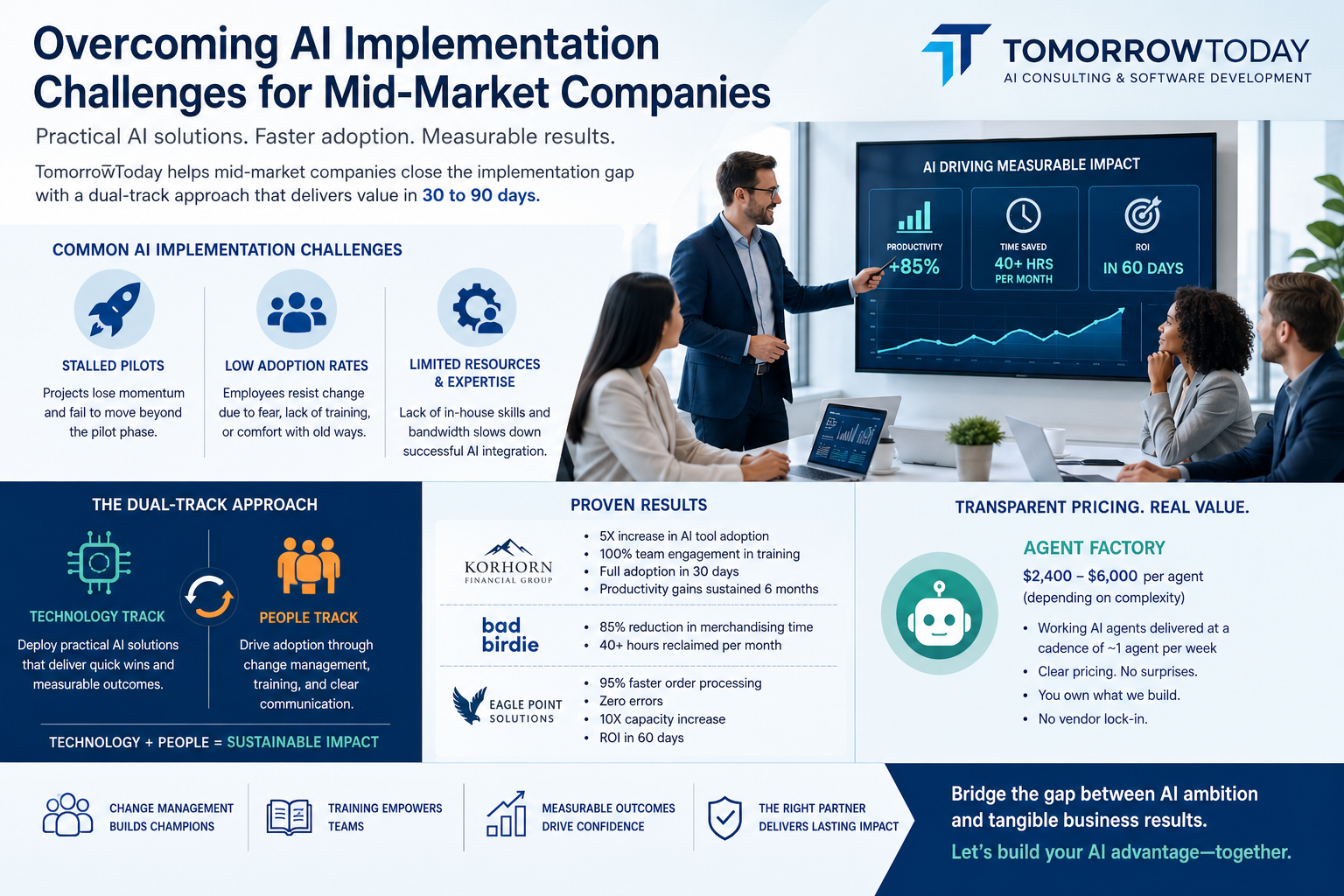
Mid-market companies often face several obstacles when implementing AI:
- Stalled Pilots: Many AI initiatives begin with enthusiasm but fail to progress beyond the pilot phase, resulting in wasted resources and unmet expectations.
- Low Adoption Rates: Employees may resist adopting new AI tools due to inadequate training, fear of job displacement, or a preference for existing workflows.
- Limited Resources and Expertise: Mid-market companies often lack the in-house expertise and resources to manage AI integration effectively, leading to implementation challenges.
The Importance of a Dual-Track Approach
To overcome these challenges, a Dual-Track Approach that combines technological solutions with change management strategies is essential. This method ensures that AI tools are not only implemented but also effectively utilized by the workforce. TomorrowToday emphasizes this approach by deploying solutions that deliver quick wins while simultaneously preparing organizations to embrace them.
This dual-track strategy means leveraging a blend of robust technical infrastructure and a strong focus on the human element. For many businesses, technology is only one half of the equation; true transformation requires buy-in from end users at all levels. Establishing strong leadership involvement, empowering internal advocates for the new tools, and providing continuous education are all elements that drive the enduring adoption of AI across teams. With a Dual-Track Approach, mid-market companies can achieve faster improvements while paving the way for sustainable culture change.
Furthermore, organizations that integrate AI technologies alongside change management are better equipped to adapt to evolving business demands. This approach helps mitigate the risk of technological obsolescence and ensures that every investment delivers operational value and improved user satisfaction. As a result, mid-market companies become more agile, competitive, and resilient in the face of constant market shifts.
Case Studies: Successful AI Adoption
Several mid-market companies have successfully adopted AI solutions, demonstrating the effectiveness of a comprehensive approach:
- Korhorn Financial Group: achieved a 5x increase in AI tool adoption across teams, 100% team engagement in the training program, full adoption achieved within 30 days, productivity gains sustained 6 months after implementation.
- Bad Birdie: reduced merchandising time by 85%, reclaiming more than 40 hours per month.
- Eagle Point Solutions: 95% faster order processing, zero errors, 10x capacity increase, and ROI in 60 days.
Transparent Pricing Models in AI Consulting
Clear, upfront pricing is crucial for building trust and ensuring successful AI projects. TomorrowToday’s Agent Factory offers transparent pricing, with agents typically costing $2,400 to $6,000 each depending on complexity. Agent Factory delivers working AI agents at a cadence of about one agent a week, helping organizations move quickly from concept to execution. This approach allows clients to understand costs before committing to development, facilitating better budgeting and decision-making. Clients own what is built. No vendor lock-in.
Transparent pricing models in AI consulting go beyond numbers; they reflect a consulting partner’s commitment to accountability and alignment with client goals. By eliminating hidden fees and clarifying deliverables at each price point, mid-market companies gain the confidence to invest in AI initiatives, knowing their expected outcomes and ROI. Moreover, flexible and predictable pricing models enable organizations to scale AI implementations gradually, reducing financial risk and making it easier to secure stakeholder buy-in for future projects. Many organizations delay action believing they can build internally later, yet stalled pilots and unclear ownership often increase costs and postpone measurable returns.
The Role of Change Management in AI Projects
Effective change management is vital to the success of AI projects. Addressing employee resistance through transparent communication and training helps build internal champions who drive AI adoption across departments. TomorrowToday runs a parallel people-focused track from day one, reducing resistance and equipping team members with role-specific training that demonstrates how AI can make their jobs easier.
Comprehensive change management plans often include workshops, feedback sessions, and open forums designed to answer employee concerns, foster collaboration, and demystify AI technologies. This focus on human factors accelerates team readiness, leading to smoother rollouts and higher sustained usage rates. For mid-market companies, where each team member can have a significant impact, proactive change management ensures that AI becomes a valuable tool in everyone’s hands, rather than just a top-down mandate. Ongoing support and accessible resources keep teams engaged, motivated, and adaptive as their AI maturity grows.
Selecting the Right AI Consulting Partner
Choosing the right AI consulting partner is critical. Criteria include experience, transparency, and a proven track record. Partnering with firms that offer both technological expertise and change management support ensures a comprehensive approach to AI implementation. TomorrowToday exemplifies this by delivering practical AI solutions and driving team adoption, resulting in measurable business impact.
It is also important for mid-market companies to seek consulting partners who provide knowledge transfer, empowering internal teams with the understanding and autonomy needed to manage AI solutions independently after deployment. The ideal partner should transfer knowledge to internal teams and align implementation with measurable business outcomes. A partnership built on trust, education, and measurable results sets the foundation for lasting innovation and sustained competitive advantage.
Conclusion
Mid-market companies can overcome AI implementation challenges by adopting a comprehensive approach that addresses both technological integration and change management. Transparent pricing and measurable outcomes are crucial for success. Partnering with experienced AI consulting firms like TomorrowToday can bridge the gap between AI ambition and tangible results, enabling organizations to leverage AI for measurable business impact.
As the business landscape continues to evolve, companies that invest in smart, strategic AI initiatives will be the ones positioned to thrive. By focusing on practical implementations, continuous training, transparent partnerships, and thoughtful change management, mid-market firms can transform AI from a buzzword into a catalyst for sustainable growth and operational excellence.