New York’s legal cannabis market spent its first two years as a punchline. It is not one anymore.
The state passed the five-year anniversary of the Marihuana Regulation and Taxation Act in March 2026 having cleared $3.3 billion in cumulative retail sales and more than 600 licensed dispensaries — a milestone marked when Pure Blossom opened on the Upper West Side as the state’s 600th licensed shop. By July, the count had climbed past 680 statewide, with roughly $895 million in combined adult-use and medical sales booked in the first six months of 2026 alone and average daily sales running north of $5 million.
Nowhere is that shift more concentrated than New York City, where the legal map has filled in fast enough that most Manhattan neighborhoods now have a licensed option within a short walk. Here’s what’s actually changed — and one of the newer arrivals worth knowing about.
The map filled in faster than anyone expected
The state’s first legal adult-use sale happened at Housing Works Cannabis Co. in Manhattan in December 2022. For most of the following year, the rollout was defined by litigation, licensing delays, and a supply chain that couldn’t keep pace.
That bottleneck has largely cleared. New York has now issued more than 2,100 adult-use licenses across the supply chain, 56 percent of them to Social and Economic Equity applicants — a figure that exceeds the statutory goal written into the law, and one of the few equity mandates in the country that has actually been met rather than aspired to. By spring 2026, roughly 250 licensed dispensaries were operating across the five boroughs.
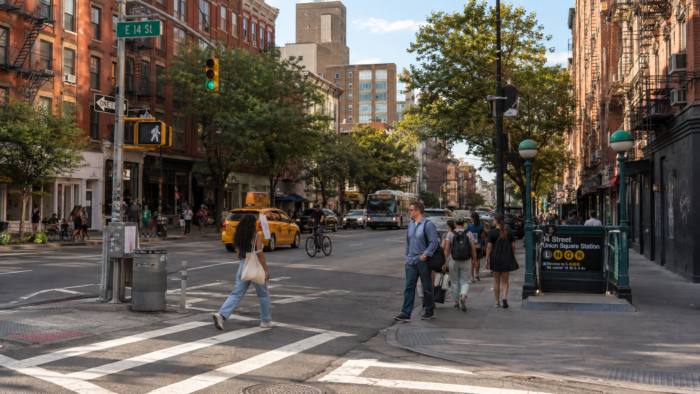
The clustering is uneven, and predictably so. Lower and Midtown Manhattan carry the heaviest density, with Union Square, the Flatiron District, and the East Village emerging as the city’s busiest legal retail corridors. Outer-borough coverage has improved but still lags, which is part of why delivery has become such a significant channel in the New York market compared to other states.
Enforcement finally changed the calculus
The reason the legal market struggled early wasn’t demand. It was that thousands of unlicensed shops opened in the gap between legalization in 2021 and the first legal sale in late 2022 — at peak, city officials estimated somewhere near 2,800 unlicensed retailers across the five boroughs, outnumbering licensed dispensaries by orders of magnitude.
Operation Padlock to Protect, launched in May 2024 once the city secured padlocking authority from Albany, changed that. Within its first year the city sealed nearly 1,400 illegal shops and seized more than $95 million in unregulated products. Enforcement has continued since, though at a smaller scale, and unlicensed sellers have adapted rather than disappeared — moving to delivery, back rooms, and referral-based sales instead of storefront signage.
For shoppers, the practical upshot is that verification matters more than vibes. Every licensed dispensary in New York is required to display the OCM Dispensary Verification Tool — a QR-coded decal — near its main entrance, and the state maintains a public list of every licensed location. A slick storefront and a good Instagram presence prove nothing. The decal does.
What a maturing market looks like from the counter
The shops opening now behave differently from the first wave. A few patterns have become standard across the better-run NYC dispensaries:
- Online ordering with in-store pickup is the default, not a bonus feature. Most menus are live, filterable by category and classification, and built for people who know what they want before they walk in.
- Payment has gotten less painful. Federal banking restrictions still keep credit cards off the table at most shops, but bank-linked apps like Aeropay, alongside cash and debit, have largely replaced the cash-only ATM shuffle that defined early dispensary visits.
- Loyalty programs and standing discounts — points back on purchases, first-purchase offers, veteran and senior discounts — have become table stakes as stores compete for repeat neighborhood traffic rather than one-time tourist visits.
- Hours have stretched. Shops serving residential and commuter corridors increasingly open early and close late rather than keeping retail-standard hours.
Meet a new First Avenue dispensary: The Yetti Club
A good example of that second-wave approach is The Yetti Club, a licensed dispensary at 317 1st Ave that has positioned itself squarely at the intersection of the East Village, Gramercy Park, Stuyvesant Town, Peter Cooper Village, and the Union Square trade area.
The location is the strategy. The shop sits about a two-minute walk from the 1st Avenue L station at 14th Street, which makes it an incidental stop on a Brooklyn–Manhattan commute rather than a destination trip, with Union Square and the L, N, Q, R, W, 4, 5, and 6 a short walk west. It’s open daily from 8:00 AM to midnight — a wider window than most of the block keeps.
The menu spans flower, pre-rolls, vapes and all-in-ones, edibles, extracts, infused beverages, tinctures, capsules, topicals, and accessories, filterable by product type or by classification. What stands out beyond the logistics is the emphasis on guidance over upsell — a team positioned to actually answer questions about format and product differences for both experienced consumers and first-timers. In a city with 250 licensed options and counting, that’s increasingly the differentiator. The shop is also pet-friendly, which in a neighborhood where the walk to the store and the walk with the dog are frequently the same errand is less trivial than it sounds.
The gap that hasn’t closed yet
For all the retail growth, one piece of the MRTA remains unbuilt: consumption lounges. New York authorized licensed on-site consumption venues in 2021, but the OCM has prioritized supply-chain and retail licensing, and effectively none are operating. The first are generally expected in late 2026 or 2027.
That leaves a real gap for visitors and for renters whose leases prohibit smoking. Buying is easy; legally consuming is not. Public consumption remains prohibited — parks included — and hotels set their own rules.
What’s next
The direction of travel is toward more access, not less. In August 2026, Governor Hochul signed legislation allowing licensed microbusinesses and dispensaries to sell at approved farmers markets, pop-ups, and community events through permitted Cannabis Showcase Events — a meaningful channel for small operators who can’t compete on Manhattan rent.
Between that, a licensing pipeline still adding shops monthly, and lounges somewhere on the horizon, the shape of legal cannabis in New York City is still being drawn. But the era of asking whether the legal market would work is over. It’s working. The question now is which shops are worth your walk.
Cannabis is for adults 21 and over. Valid government-issued ID required for purchase. New York permits adults 21+ to possess up to three ounces of cannabis flower and 24 grams of concentrate. Keep out of reach of children and pets. Please consume responsibly.