In Rock Hill, South Carolina, a tree’s health begins below ground. Hot summer stretches, sudden heavy rain, compacted neighborhood lots, and red Piedmont clay can all affect how roots access water, oxygen, and nutrients. Homeowners considering tree fertilization in Rock Hill, SC, should start by looking at the soil and the entire growing site, not just the leaves overhead.
Fertilizer can be useful when a genuine nutrient shortage is present, but it cannot solve drainage failures, damaged roots, limited soil volume, or chronic drought. A healthier approach is to build stable conditions around the root zone, then use nutrients carefully when testing and tree symptoms support the decision.
Why the Root Zone Deserves More Attention
The root zone is a living system of fine roots, fungi, microbes, organic matter, moisture, and pore spaces that hold oxygen. Damage in this area may take months to appear above ground. A tree can look reasonably stable while its roots are struggling with compaction, buried debris, repeated foot traffic, or poor drainage.
This matters in established Rock Hill neighborhoods, where mature trees may grow beside driveways, patios, lawns, and utility corridors. The same oak that performs well in an open woodland may have a much smaller, harder, and drier rooting area in a residential yard.
Strong roots also support better stability when severe weather arrives. Protecting soil structure, removing hazards, and evaluating vulnerable trees as part of tree storm prep in Rock Hill, SC, can help reduce stress before wind and saturated soil test a tree’s anchorage.
How Urban and Residential Soil Differs From Forest Soil
Forest soil is usually layered with fallen leaves, decomposing wood, active organisms, and relatively undisturbed root pathways. Yard soil is often shaped by grading, construction, lawn maintenance, paving, and digging. It may contain shallow topsoil, compacted subsoil, concrete fragments, or areas where water collects after a Carolina downpour.
According to USDA guidance on urban soil conditions and nutrient cycling, healthy urban trees depend on adequate soil volume, texture, drainage capacity, organic matter, and nutrient availability. Those basics often matter more than simply adding a fertilizer product.
The Main Soil Factors That Affect Trees
Soil Structure
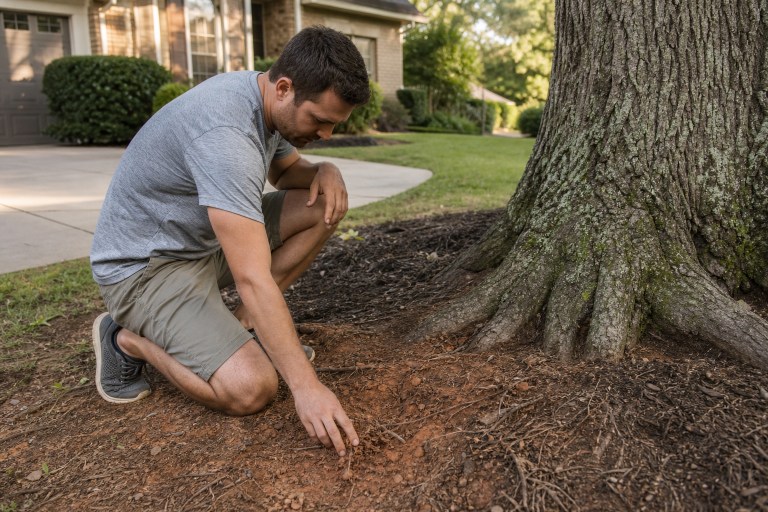
Well-structured soil contains connected pores that allow water to infiltrate and roots to receive oxygen. Compacted soil closes those spaces, slows root expansion, and can leave water sitting near the surface after rain while deeper roots remain oxygen-starved.
Moisture and Drainage
Both dry and waterlogged conditions injure roots. Deep, occasional watering is generally more helpful than frequent shallow watering because it moistens a larger portion of the active root zone. Check the soil before irrigating, especially in clay-heavy sites where the surface can look dry while lower soil remains wet.
Soil pH, Organic Matter, and Biology
Soil pH influences how readily roots can absorb nutrients. Adding lime, sulfur, or fertilizer without a test can create a new imbalance. Organic matter from leaves and properly applied mulch improves moisture moderation and soil structure over time. The USDA’s principles for healthy, living soil also emphasize soil cover, living roots, nutrient cycling, biodiversity, and reduced disturbance.
Signs of a Soil or Nutrition Problem
Possible warning signs include pale or unusually small leaves, short annual shoots, sparse canopy areas, weak flowering or fruiting, early leaf drop, dead twigs, and recurring dieback. However, these symptoms can also result from drought, poor light, insects, disease, root injury, improper planting depth, or herbicide exposure.
Before treating a tree, inspect the full site. Look for exposed roots, standing water, mower wounds, recent construction, changes in drainage, and competition from turf or invasive plants. The visible canopy is only one part of the diagnosis.
Why Soil Testing Should Come Before Fertilizer
- Collect samples from several points within the tree’s active root area.
- Follow the laboratory’s instructions for depth, timing, and sample handling.
- Review pH, nutrient levels, organic matter, and any other reported findings.
- Compare results with the tree species, age, symptoms, and site history.
- Select a treatment only when there is a likely need to address.
Testing can prevent wasted money, salt buildup, nutrient runoff, and excessive nitrogen. It also helps separate a true fertility issue from the far more common problems of restricted roots, poor drainage, and inconsistent moisture.
When Fertilizing Helps, and When It Hurts
Fertilizer may make sense when testing confirms a deficiency, when trees grow in limited root zones, or when a site has persistently low fertility. Slow-release products provide nutrients gradually, while quick-release products act faster but carry a greater risk of pushing tender growth or leaching away.
Do not use fertilizer as a rescue treatment for severe root damage, standing water, active disease, or heat stress. Avoid applying lawn fertilizer by guesswork, placing high-nitrogen material against the trunk, or feeding trees during extreme drought. Too much nitrogen can produce fast, weak growth that is less prepared for summer stress and winter cold.
A Practical 2026 Tree Soil Care Plan
- Inspect the site: Identify compaction, drainage trouble, exposed roots, and construction damage.
- Track canopy changes: Note leaf color, density, shoot growth, and dieback through the season.
- Test when needed: Use soil data before making major nutrient applications.
- Improve the basics: Maintain a mulch layer, protect roots, and water according to soil moisture.
- Apply nutrients selectively: Match the product and rate to the tree and test results.
- Review results: Monitor the tree over the next growing season instead of expecting an overnight change.
Seasonal Checklist for Rock Hill Trees
- Spring: Check new growth, winter injury, compacted areas, and soil-test needs.
- Summer: Watch for scorch, wilt, early leaf drop, and drought stress. Keep trimmers away from trunks.
- Fall: Refresh mulch without piling it against bark, carefully reduce weeds, and assess the year’s growth.
- Winter: Inspect drainage, exposed roots, and damaged limbs. Plan soil work before active growth resumes.
Build Better Conditions Before Adding More Products
Yellow leaves do not automatically mean fertilizer; newly planted trees often need water and mulch more than feeding, and deep root applications are not always better for shallow-rooted trees or wet sites. Strong trees in Rock Hill start with healthy root zones. Improve soil structure, moisture balance, rooting space, and protection from damage first, then use fertilizer as one targeted tool within a thoughtful long-term care plan.