
A cash offer can be appealing when you need certainty, fewer showings, or a faster path to closing. Before accepting, compare the written offer with a realistic estimate of what the property could sell for on the open market. Services that help homeowners evaluate we buy houses fast offers can provide a useful starting point, but the final decision should account for every cost, deadline, and contract term.
The largest offer is not automatically the best deal. A traditional buyer may offer more, yet repairs, agent compensation, buyer concessions, months of carrying costs, and financing uncertainty can reduce what you actually receive. A lower cash offer may produce a stronger outcome if it eliminates expenses or solves an urgent timing problem.
Key Takeaways
- Compare estimated net proceeds, not just the price printed at the top of an offer.
- Cash buyers typically do not rely on mortgage approval, but their contracts can still include inspection or due-diligence terms.
- Market value is an estimate, not a promise of a final sale price.
- Repair needs, closing costs, liens, and the cost of waiting can materially affect your result.
- Review the buyer, proof of funds, contract deadlines, and cancellation language before signing.
Why the Highest Number May Not Be the Best Deal
A home sale has more than one important number. The contract price matters, but so do the costs required to reach closing. For example, a listed home may need cleaning, repairs, staging, photography, and buyer-requested credits. It may also remain on the market longer than expected. During that time, the owner may continue to pay the mortgage, taxes, insurance, utilities, and maintenance.
A direct cash sale can reduce some of those steps. This may be valuable for an owner who cannot fund repairs, needs to relocate, or wants to avoid preparing the home for repeated showings. On the other hand, a well-maintained home in an area with strong buyer demand may be more likely to benefit from broad market exposure and competing offers.
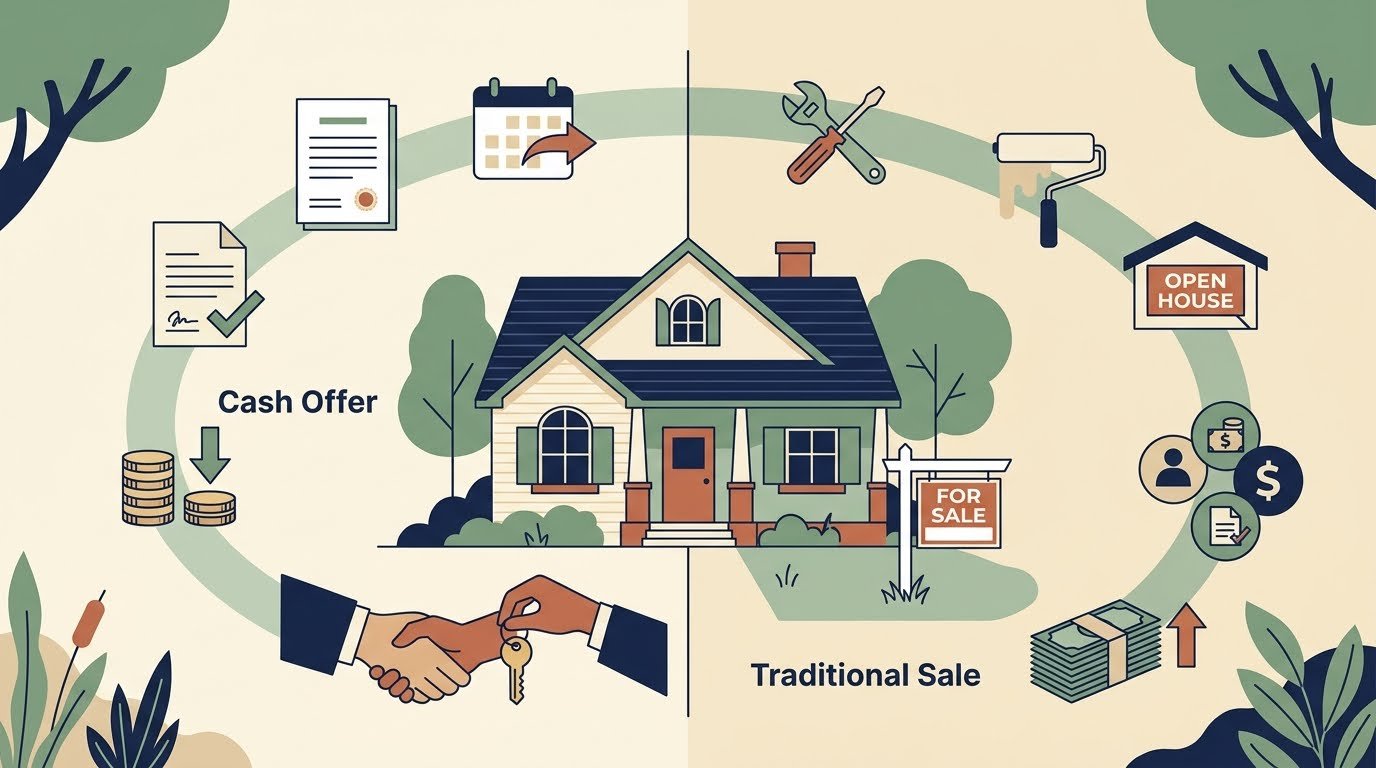
What a Cash Home Offer Usually Includes
A cash offer is an offer from a buyer who states they can complete the purchase without obtaining a mortgage. It may be structured as an as-is purchase with a shorter closing timeline, but the details vary. Do not assume that “cash” means the price cannot change or that the buyer has no conditions.
Request the full purchase agreement and confirm these terms in writing:
- The purchase price and earnest money deposit.
- The proposed closing date and who selects it.
- Any inspection, due-diligence, or financing-related contingencies.
- Whether the buyer can request repair deductions or terminate after inspection.
- Which party pays closing costs, title charges, transfer taxes, or attorney fees.
- Whether the buyer may assign the contract to another party.
- What happens if either party does not close on time.
Market Value Is a Benchmark, Not a Guaranteed Sale Price
Online estimates, comparative market analyses, broker price opinions, and formal appraisals can all produce different results. They may rely on different comparable sales, property details, valuation dates, and assumptions about condition. The Consumer Financial Protection Bureau explains that valuations can differ because they are estimates prepared for different purposes.
Use a value range rather than treating one number as absolute. Recent nearby sales are helpful only when the homes are genuinely comparable in size, location, condition, features, and sale date. Be candid about deferred maintenance, additions, damage, and upgrades, since those details can affect a buyer’s price.
How To Calculate Expected Net Proceeds
A practical comparison begins with this formula:
Expected Net Proceeds = Sale Price − Selling Costs − Repairs − Concessions − Carrying Costs − Loan Payoff
- Sale price: The cash offer or the likely price range from an open-market sale.
- Selling costs: Potential agent compensation, title charges, transfer taxes, attorney fees, and other closing expenses.
- Repairs and concessions: Work completed before sale or credits given to the buyer.
- Carrying costs: Ongoing mortgage payments, property taxes, insurance, utilities, and upkeep before closing.
- Loan payoff: The amount required to satisfy mortgages, home equity loans, and other valid liens.
A Simple Side-by-Side Comparison
Consider this illustration only, not a prediction of any home’s outcome:
- Cash sale: $285,000 offer, $5,000 in selling costs, and $2,000 in carrying costs. Estimated proceeds before loan payoff: $278,000.
- Traditional sale: $315,000 expected sale price, $18,000 in repairs and preparation, $21,000 in selling costs, and $8,000 in carrying costs. Estimated proceeds before loan payoff: $268,000.
In this example, the lower offer creates a higher estimated result because the assumed costs are lower. In another situation, the open-market sale could produce more. The answer depends on the property, local demand, repair budget, timeline, and tolerance for uncertainty.
When Each Option May Make Sense
Situations Where a Cash Offer May Fit
- An inherited property must be settled among multiple family members.
- The home needs substantial work, and the owner cannot fund it.
- A relocation, family obligation, or vacant property creates a firm deadline.
- The owner wants to avoid showings, extensive preparation, or a prolonged listing process.
Situations Where Listing May Deserve Consideration
- The property is in good condition and supported by strong comparable sales.
- The seller has time for cleaning, repairs, marketing, and buyer showings.
- Multiple buyers may compete for the home.
- The likely difference in net proceeds justifies the added effort and time.
Questions To Ask Before Accepting an Offer
- Who is the legal buyer named in the purchase agreement?
- Can the buyer provide reasonable proof of funds?
- Can the buyer assign the contract?
- When can the buyer cancel, renegotiate, or request a price reduction?
- How much earnest money will be deposited and when?
- Which title company, escrow agent, or closing attorney will handle the transaction?
- What costs will be deducted from the seller’s proceeds?
Warning Signs That Deserve More Research
Pressure to sign immediately, vague fee explanations, unclear assignment language, requests for upfront payments, or instructions to transfer a deed before closing all warrant caution. Homeowners facing financial stress should be especially careful because the Federal Trade Commission warns that mortgage relief scams can target people at risk of foreclosure. Use an established closing professional, independently verify wire instructions, and consider having a real estate attorney review a contract you do not fully understand.
A Five-Step Review Process
- Get a realistic market-value range based on recent comparable sales and actual condition.
- Request every offer and addendum in writing.
- Calculate estimated net proceeds for each path.
- Verify the buyer’s identity, funds, and proposed closing process.
- Review deadlines and cancellation provisions before signing.
Common Questions About Cash Offers
Is a cash offer always below market value?
No. The amount depends on the home, its condition, local demand, and the contract terms. Cash buyers often account for repair costs, resale risk, and the value they place on a quick, certain closing.
Does “as-is” prevent inspections?
Not necessarily. An as-is term generally means the seller does not agree to make repairs, but the contract may still give the buyer an inspection or due-diligence period.
Can a seller negotiate a cash offer?
Often, yes. Price, closing date, earnest money, inspection timing, closing costs, and personal property are all terms that may be negotiable.
Compare the Money, Terms, and Timing
A cash offer can provide a practical solution, but speed should not obscure its full financial effect. Compare the offer against a reasonable market-value range, subtract all expected expenses, and read the contract carefully. A decision based on net proceeds, closing certainty, and personal priorities is more useful than one based on the headline offer alone.