
Just to not waste your time, yes, bleach kills maggots, and a strong solution poured straight onto them drops most within seconds to a couple of minutes. The active ingredient, sodium hypochlorite, wrecks their cells and breaks down the proteins holding them together, so a direct hit works fast. The caveat nobody mentions: maggots that dodge the solution or burrow under trash survive the splash, which is why the “just pour bleach on them” advice fails more often than the internet admits. There’s also a safety asterisk. Bleach reacts with the ammonia already sitting in your bin to make chloramine gas, and standard household safety guidance flags that trash cans almost always carry that residue. The honest answer is a fast yes with a real safety catch, and boiling water does the same job for free.
Yes, Bleach Kills Maggots, and Here’s How It Does Fast
Bleach kills maggots, and a strong solution poured straight onto them drops most within minutes. The active ingredient, sodium hypochlorite, disrupts their cells and denatures the proteins their bodies rely on, so a direct hit works fast. A closed-lid fume treatment, where you pour diluted bleach in and shut the bin to trap the vapor, takes longer because it relies on the fumes suffocating larvae rather than soaking them. Both work. One is quick and messy, the other is slow and passive. Which you pick depends on how many maggots you’re staring at and whether you can stomach leaning over the bin. That last part matters more than most guides let on, and it’s the reason the next few sections spend so much time on ratios and gas.
On contact vs. instantly
“On contact” and “instantly” are not the same thing. Douse maggots directly with a bleach solution and they die in seconds to a couple of minutes as the chemical burns through their tissue. Pour bleach into a lidded bin and walk away, and you’re looking at roughly 30 minutes for the fumes to do their work. Nobody clears a bin with one splash and a five-second wait. Set the timer, or you’ll be back tomorrow.
The Bleach-to-Water Ratio That Actually Works to Kill Maggots
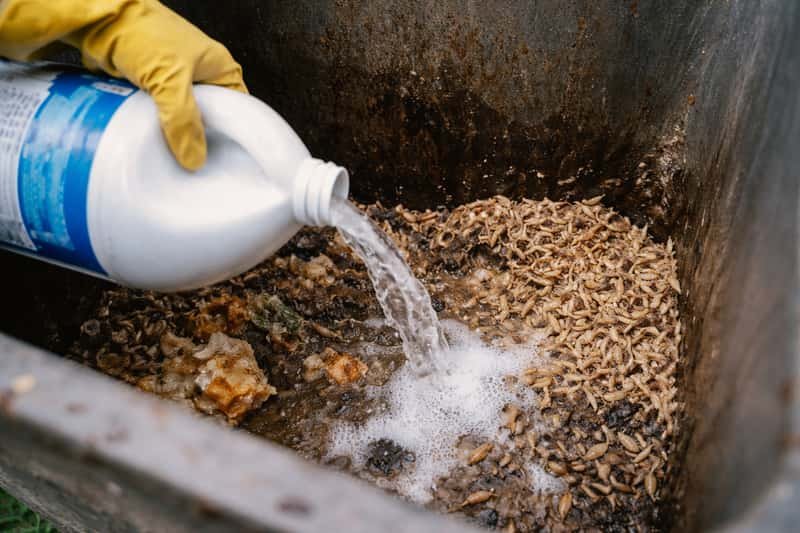
Here are the ratios you came for. Get these right and you skip the “why are there still maggots” rerun.
- 1:10 bleach to water for surface disinfecting plus a kill. Good for wiping down a bin’s interior or hard floors where you also want the area sanitized.
- closed-bin treatment. This is the strong mix that suffocates larvae over about half an hour.
- Stronger than 1:1 is not smarter. Higher concentration means more fumes, more surface damage, and a bigger gas risk if ammonia is present. You gain almost no extra kill speed past 50/50.
Weak dilution is the quiet failure point. A splash of near-water solution soaks a few maggots and lets the rest wriggle off. Match the ratio to the job, then commit to full coverage and full contact time.
How to kill maggots in a trash can with bleach
Common cleaning guides describe the closed-lid method like this, and it’s fume-based, not lab-tested.
- Mix a 1:1 bleach-to-water solution in a bucket.
- Pour it over the maggots so they’re soaked, not sprinkled.
- Close the lid and let the trapped fumes work for roughly 30 minutes.
- Rinse the bin thoroughly, drain the runoff safely, and dry it in the sun.
Gloves, Ventilation, Eye Protection
Before you pour anything, put on rubber gloves and eye protection, and work in open air. Do not lean your face into a confined bin while bleach fumes are rising. That single move is how people end up coughing over a garbage can, and it sets up the exact hazard the next section is built around.
The Chloramine-Gas Mistake Most Guides Skip
Bleach reacts with ammonia to form chloramine gas, and a bin full of rotting food residue almost certainly contains ammonia. Whatever attracted the flies left ammonia behind, so pouring bleach in is a coin flip on whether you also brew a toxic cloud. The CDC’s safe household use guidance is blunt about never combining bleach with other cleaners, and this is why. Mixing bleach with vinegar or a drain cleaner belongs in the same category of mistake. Different gas, same trip to a bad afternoon.
Why the “stronger” chemical is the more dangerous one here
Reaching for bleach feels like the heavy-duty fix, the sledgehammer for the job. But the combination that actually plays out is a confined bin, plus ammonia residue, plus your face hovering over the opening. That’s the wrong three ingredients in one place. The “stronger” chemical becomes the more dangerous choice precisely because it reacts with what’s already in the bin, while boiling water reacts with nothing at all.
The never-mix list
- Ammonia: forms chloramine gas, which irritates lungs and eyes fast.
- Vinegar: the acid releases chlorine gas, which is genuinely dangerous.
- Drain cleaner: unpredictable violent reactions and toxic fumes.
- Other household cleaners: many contain ammonia or acids you can’t see on the label.
Why Some Maggots Survive Bleach
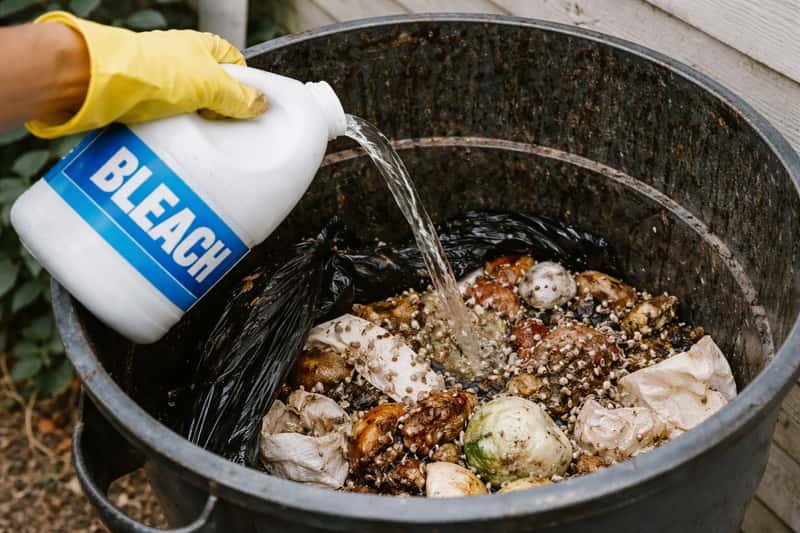
Maggots are tougher than they look. They tolerate harsh, low-oxygen, high-decay environments by design, and they squirm away from anything that touches them. That means partial exposure gives partial results. A biology-focused review notes that complete extermination of a large infestation with bleach alone is unlikely. One pour rarely clears a heavy bin because half the larvae are buried under trash or wedged in a crevice the solution never reaches.
Dosing, contact time, and full coverage
Survival traces back to execution every time. Weak dilution, short contact time, and maggots hidden under a layer of garbage all leave living larvae behind. The fix is unglamorous. Soak every maggot fully, keep the solution on them for the full window, and expose the ones tunneling under trash by stirring the top layer first. Full coverage for long enough is the line between a fix and a repeat performance.
Bleach vs. Boiling Water vs. Salt vs. Vinegar
Speed and cost sort these fast. Here’s the side-by-side so you pick by situation instead of habit.
| Method | Kill speed | Cost | Main downside |
|---|---|---|---|
| Boiling water | Instant, on contact | Free | Careful pour, splash risk |
| Bleach (1:1) | Seconds direct, ~30 min fumes | Low | Chloramine gas risk, fumes, stains |
| Salt | Slower, dries them out | Very low | Needs time, heavy coverage |
| Vinegar | Slowest | Low | Weak killer, good for odor |
The case for boiling water
Boiling water kills maggots on contact, costs nothing, and releases no toxic fumes. It’s the instant option and it works the second it lands. Recent trash-bin guides put it at the top of the list for exactly that reason. You already own a kettle, the runoff is just hot water, and there’s no chemistry to fear when it hits bin residue. Bleach kills fast on direct contact but lags on the closed-bin route, salt takes real time to dry larvae out, and vinegar is the slowest of the group, though it earns a spot for cutting the smell that drew the flies in. For most trash-can situations, boiling water beats bleach on both speed and safety. The stronger chemical loses to the pot on your stove.
Where You Should Not Use Bleach
Bleach belongs on hard, rinseable surfaces, not everywhere a maggot shows up. Pour it in the wrong spot and you trade a maggot problem for a plumbing, garden, or flooring problem. Three cases deserve a hard stop.
Drains, compost, and porous indoor surfaces
- Drains: pipes trap fumes and may hold residual cleaner that reacts with bleach. Use boiling water flushed through instead.
- Compost: bleach kills the beneficial microbes that make compost work, right alongside the maggots. Turn the pile, add dry browns, and let heat handle it.
- Porous indoor surfaces: wood, grout, and fabric soak bleach in and stain permanently. Scrape and remove the maggots, then clean with soapy hot water.
What Bleach Does to Soil and Storm Drains
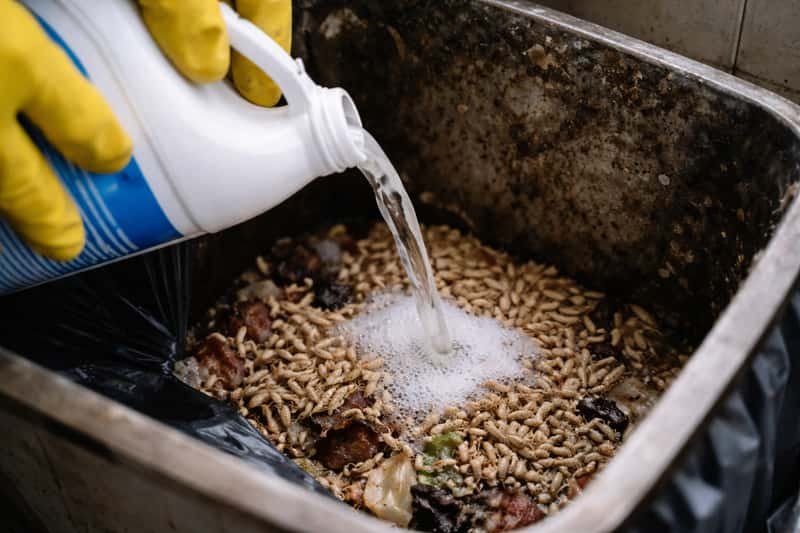
The runoff has a second life most guides ignore. Dump bleach solution into soil and it kills plants and the microbes that keep dirt alive. Pour it down a storm drain and you send chlorine straight toward local waterways, since storm drains usually skip treatment and empty into streams. EPA-style disinfectant and runoff guidance treats chlorine as something to keep out of the environment, not something to dump in the yard because it’s convenient.
Dispose of the solution the right way
Dilute the used solution heavily with water, then pour it down a sanitary drain, the kind connected to sewage treatment, like a toilet or utility sink. Keep it out of the garden, the storm grate, and anywhere pets sniff around. A little care on disposal keeps the fix from becoming a bigger mess downstream.
Keeping Maggots From Coming Back
One treatment solves today. Prevention solves next week. Bag food waste tightly so flies can’t reach it, rinse and dry the bin after every empty, keep the lid shut, and park bins out of direct heat where decay and egg-laying speed up. This is the fix that outlasts any single pour of bleach or kettle of boiling water, because it removes the reason maggots appeared at all.
Fly control at the source
Maggots mean flies got there first and laid eggs. Cut off the adults and you cut off the larvae before they hatch. Screen windows near bins, wipe up food spills fast, and seal food waste in tied bags. No eggs, no maggots, no repeat of this whole ordeal.
Odd Culture’s Read
Here’s the one move most people skip: before you pour anything, bag and pull the worst of the trash first. A near-empty bin gives the maggots nowhere to hide and cuts the ammonia load that fuels the gas risk, so whatever you use next works faster and safer. Treat the drenching as step two, not step one, and you’ll rarely need a second round.
FAQs about does bleach kill maggots
How long does it take for bleach to kill maggots?
Direct dousing with a strong bleach solution kills maggots in seconds to a couple of minutes. A closed-lid fume treatment, where you pour bleach in and shut the bin, takes roughly 30 minutes.
Does bleach kill maggots instantly?
Not quite instantly, but close on direct contact. A concentrated solution poured straight onto maggots kills within seconds to two minutes. The only truly instant option is boiling water, which kills the moment it lands.
How fast does bleach kill maggots in a closed trash can?
Expect about 30 minutes for the fume method. You pour a 1:1 bleach-to-water mix in, close the lid to trap the vapor, and let it suffocate the larvae before rinsing and draining.
Does bleach kill maggots on contact?
Yes. Maggots that get fully soaked in a strong bleach solution die on contact within seconds. The problem is coverage. Any maggot that dodges the solution or hides under trash survives the splash.
What is the bleach-to-water ratio for maggots?
Use 1:1 (50/50) for an aggressive closed-bin fume treatment and 1:10 for surface disinfecting with a kill. Stronger than 1:1 adds fumes and stain risk without meaningfully faster results.
Does Clorox bleach kill maggots better than generic bleach?
No. Clorox and store-brand bleach both run on sodium hypochlorite, so concentration decides the outcome, not the label on the jug. Most household bleach runs 5 to 8 percent, so an equal-strength generic does the identical job. Pay for the name if you want, but the maggots can’t read.
Does bleach kill maggots in a trash can safely?
It can, but with a catch. Bins usually hold ammonia residue from rotting food, and bleach plus ammonia makes chloramine gas. Ventilate, wear gloves and eye protection, and never lean your face into the bin.
What kills maggots instantly if I don’t want to use bleach?
Boiling water. It kills maggots on contact, costs nothing, and releases no toxic fumes. Pour it directly over the larvae, and it works the second it touches them, no chemistry required.
Can I pour bleach down a drain to kill maggots?
Avoid it. Drains trap fumes and may hold residual cleaner that reacts with bleach. Flush boiling water through the drain instead, which clears larvae without the gas or reaction risk.
Will bleach damage my yard or waterways if I dump the solution?
Yes. Bleach solution kills plants and soil microbes, and pouring it into a storm drain sends chlorine toward local waterways. Dilute heavily and empty it down a sanitary drain like a toilet instead.