
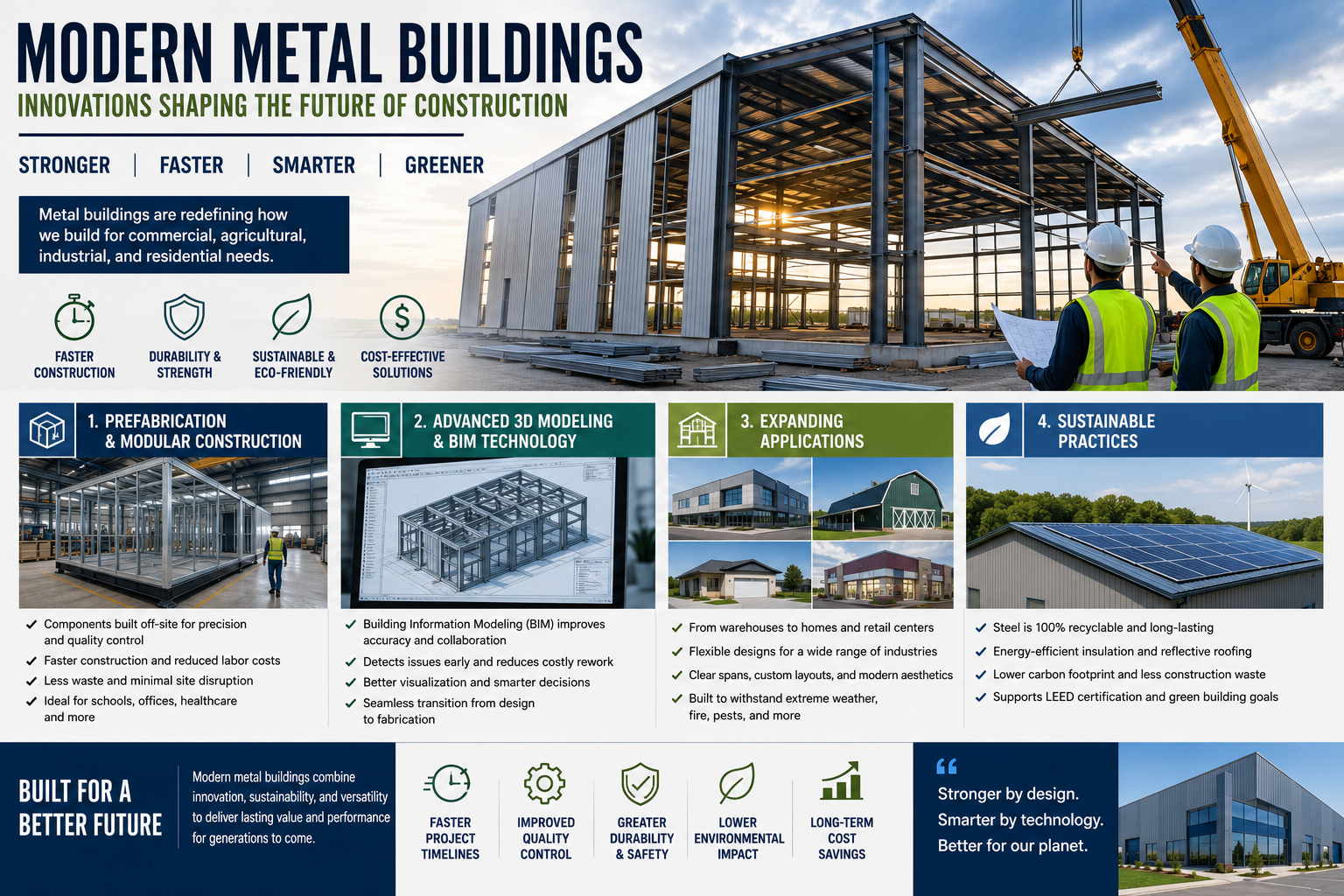
Modern metal buildings are ushering in a new era in the construction industry. Their rapid assembly, cost-efficiency, and environmental benefits are redefining how projects are approached across commercial, agricultural, and residential markets. Contractors and property owners are increasingly turning to suppliers like this building material supplier to source high-quality products that support these innovations.
From prefabrication to cutting-edge digital design, the advancements in metal buildings are not just technological; they are practical and sustainable. These structures now serve a broader spectrum of needs, offering flexibility in application alongside eco-conscious construction methods.
Prefabrication and Modular Construction
Perhaps the most transformative trend in modern metal buildings is the rapid adoption of prefabrication and modular construction. Manufacturing components off-site under controlled conditions allows for precise assembly, which drastically reduces construction schedules. As these sections arrive on-site ready for installation, wasted time and material are minimized, resulting in significant savings on both budget and labor.
Modular construction also improves quality control and safety, as much of the fabrication occurs in factories rather than open construction sites with shifting variables. These efficiencies explain why builders increasingly favor prefab metal structures for schools, office buildings, and even healthcare facilities. According to Forbes, prefabrication is reshaping the construction industry, impacting not just costs but also the speed and scalability of new projects.
Another benefit of prefabrication and modular construction is its adaptability across different climates and locales. Factories can produce components that are engineered to match specific structural and environmental requirements, allowing metal buildings to thrive in both harsh winter conditions and extreme heat. This adaptability, combined with reduced site disruption and noise, also makes modular construction particularly suited for infill projects or sites with limited access.
Increasingly, new technologies are being integrated into the prefabrication process. Robotics, automation, and digital twins (virtual copies of physical assets) enable unparalleled consistency and predictability. These advancements reduce manufacturing errors while also enabling complex geometry and innovative design options that traditional methods might have deemed too costly or difficult to execute. The convergence of technology and off-site assembly is revolutionizing the way entire neighborhoods or commercial zones can be built efficiently.
Advanced 3D Modeling
The widespread embrace of 3D modeling has revolutionized every stage of metal building design and construction. Building Information Modeling (BIM) lets engineers and architects create highly detailed representations of the finished structure before a single beam is cut. This enhanced visualization allows teams to foresee and resolve conflicts early, tailor solutions to client needs, and streamline collaboration among all stakeholders.
The move from 2D blueprints to interactive 3D simulations enables the design of unique structures with unprecedented precision, from complex rooflines to expansive interiors. It reduces errors and rework during construction while empowering clients to visualize results and make informed decisions much earlier in the process. A recent report by Architectural Digest highlights how this technology-driven approach is increasing accuracy and creativity across the field.
In addition, 3D modeling-based workflows are now directly connected to fabrication machinery, creating a seamless pipeline from digital concept to real-world components. This direct link minimizes miscommunication between stakeholders and ensures that the building is constructed exactly as envisioned by its designers. Many firms are also leveraging Virtual Reality (VR) walkthroughs and Augmented Reality (AR) overlays to further engage clients, facilitate approvals, and enhance stakeholder collaboration.
With better simulation capabilities, project risks are reduced by accurately previewing performance under various loads and stresses. Energy efficiency can also be modeled, tested, and optimized early in the design phase, setting new standards for both sustainability and client satisfaction.
Expanding Applications
Modern metal buildings have evolved beyond their traditional role as industrial warehouses and storage facilities. Their adaptability and strength now make them ideal for a wide variety of uses, including retail stores, schools, agricultural barns, recreational centers, and even sleek, modern homes. This transformation is partly due to the flexibility and efficiency inherent in metal-based construction, allowing for diverse floor plans and customizable features.
Many architects have embraced contemporary metal buildings for their ability to support expansive windows, clear spans, and creative facades, which appeal to clients seeking both utility and visual impact. As societal needs shift, the metal building sector’s willingness to adapt ensures its continued relevance in both urban and rural environments.
Furthermore, the durability and low maintenance requirements of metal buildings make them attractive in disaster-prone areas. Metal structures can resist pests, mold, fire, and extreme weather, providing peace of mind to property owners. Residential designers are taking note, incorporating steel frames into custom home projects for both their reliability and modern aesthetic appeal. In the agricultural sector, barns and storage buildings now feature specialized climate controls and automation compatible with today’s smart farming techniques, bringing even greater value through technological integration.
Metal buildings are also playing a key role in the rise of mixed-use developments, where residential, retail, and office spaces are integrated within the same footprint. Their span capabilities and flexible partitions support a wide range of tenant needs and make it easier for developers to future-proof properties for changing market demands.
Sustainable Practices
Sustainability is a priority in today’s construction industry, and metal buildings are leading the way with eco-friendly approaches. Steel, the most commonly used metal, is 100 percent recyclable with no loss in structural integrity, making it a responsible material choice. The construction process itself uses less energy and produces fewer greenhouse gases compared to traditional materials.
In addition to recycled content, the design of metal buildings often includes advanced insulation systems and reflective roof coatings. These features help lower energy consumption throughout a building’s lifecycle by maintaining consistent indoor temperatures and reducing reliance on heating and cooling equipment. These sustainable strategies are crucial steps toward reducing the overall environmental impact of the built environment.
Manufacturers are also innovating with paints and coatings that reduce solar heat gain and resist corrosion, thereby extending a building’s life span and improving its performance. Many metal building systems now qualify for LEED (Leadership in Energy and Environmental Design) certification, and owners may benefit from tax incentives or increased property value when they invest in green construction methods. Integrating renewable energy sources, such as solar panels or wind turbines, is easier with metal roofing systems because of their durability and adaptability. These eco-friendly frameworks strengthen the case for metal buildings as a core component of sustainable development strategies worldwide.
Additionally, waste generated during the construction of metal buildings is typically much lower than that from wood or masonry builds. What little scrap is created is often reused or recycled within the supply chain, demonstrating a closed-loop approach that aligns with circular economy principles. With stricter building codes and ever-rising public awareness about climate change, metal buildings are set to remain at the forefront of sustainable construction innovation.
Conclusion
The rise of modern metal buildings represents a true paradigm shift in construction. By adopting prefabrication, advanced digital modeling, flexible designs, and sustainable materials, today’s metal structures offer unmatched speed, efficiency, and performance. These innovations provide practical solutions for a changing world and ensure that metal buildings play a central role in the future of construction.
As technology continues to evolve, stakeholders across the construction industry will find even more versatile, energy-efficient, and resilient solutions in metal building systems. Whether constructing warehouses, homes, schools, or retail centers, the combination of technological innovation, reduced environmental impact, and adaptability makes modern metal buildings a compelling choice for today’s and tomorrow’s needs. Continued research and education in this sector will further drive advances, ensuring that metal construction meets the highest standards of quality, safety, and sustainability in years to come.