
Yes, the driving modes in a Cadillac Lyriq change how fast the same 102 kWh Ultium pack drains and how efficiently you cover ground, but they never touch the fixed EPA-rated range of roughly 308 to 326 miles. Drive hard in Sport for a year and you can quietly hand back 30 to 60 miles per charge, which stacks into extra charging stops and a bigger electricity bill. Tour, Sport, Snow/Ice, and My Mode each carry a real cost, and this piece puts numbers on all of them so you know exactly what you’re spending.
What Driving Modes Actually Change on the Lyriq
Here is the clean answer. Lyriq drive modes adjust throttle response, power delivery, traction control, and how regenerative braking feels. They do not resize the battery or unlock a hidden reserve. What shifts is efficiency, meaning miles per kWh, which is why the same full charge can carry you 20 to 70 miles farther or shorter depending on what you pick. The mode-to-mode efficiency figures cited throughout this post are owner-reported estimates aggregated from EV community trackers like the InsideEVs owner surveys and the A Better Route Planner efficiency database, not lab-certified numbers.
Think of the modes as personality settings for the same physical hardware. Tour keeps power delivery balanced. Sport sharpens throttle and encourages higher average draw. Snow/Ice softens response for grip. My Mode lets you mix your own recipe. None of that changes the certified number on the window sticker.
The trap is assuming the mode label alone decides your range. It doesn’t. It sets the ceiling for how aggressive the car will let you be, and your right foot does the rest.
Why the 102 kWh Battery and EPA Range Never Move
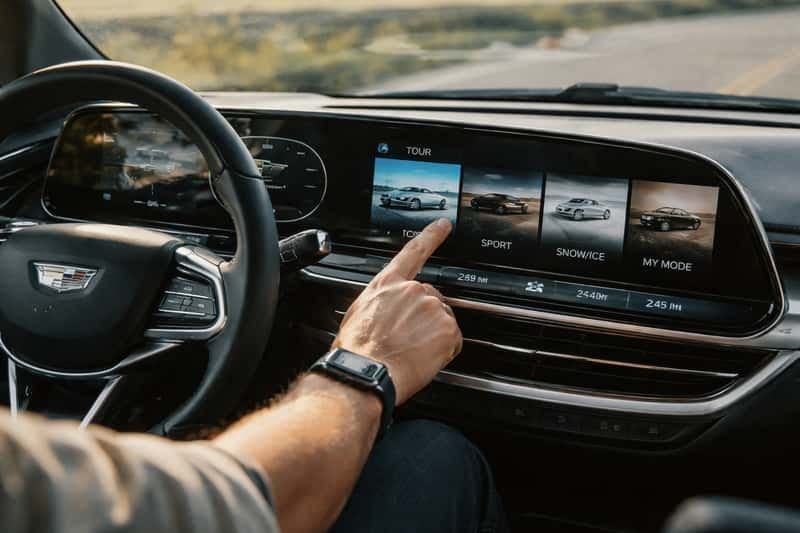
The Lyriq’s 102 kWh battery is a fixed quantity of usable energy. Selecting Sport does not shrink it, and selecting Tour does not grow it. The pack, the buffer, and the usable capacity stay identical across every mode. What changes is the rate you spend that energy.
The EPA-rated range sits at roughly 308 to 326 miles for rear-drive configurations and about 285 to 319 miles for all-wheel drive, according to Cadillac’s published figures and EPA fuel economy ratings. That certified number is a lab result, not a live readout, so it never budges when you tap a mode button.
How the EPA Test Cycle Sets the Number
The EPA range comes from a standardized test cycle run under controlled conditions, not from your commute. It uses a fixed drive pattern, so mode selection, cold mornings, and 80 mph highway pulls never enter the equation. That is exactly why owners routinely see real-world numbers land above or below the sticker. The rating answers “how far under lab conditions,” while your dash answers “how far the way you actually drive.” Those are two different questions, and only one of them changes with your foot.
Tour Mode is the Baseline Everyone Should Measure Against
Tour is the mode tuned for balanced performance and efficiency, and in normal driving it lands closest to the full EPA number. If you want to know what any other mode costs you, measure it against Tour, not against the window sticker.
Set a Lyriq to Tour, drive moderately, and range typically comes in near that 308 to 326 mile band, assuming mild weather and reasonable speeds. Owners on the InsideEVs and A Better Route Planner databases commonly report efficiency around 3.3 to 3.7 miles per kWh here, which on a 102 kWh pack pencils out to roughly 336 to 377 miles in ideal conditions and dips toward the EPA figure in mixed driving.
Tour is boring on paper and correct in practice. It is the number every honest comparison starts from.
Sport Mode and What the Range Loss Actually Costs
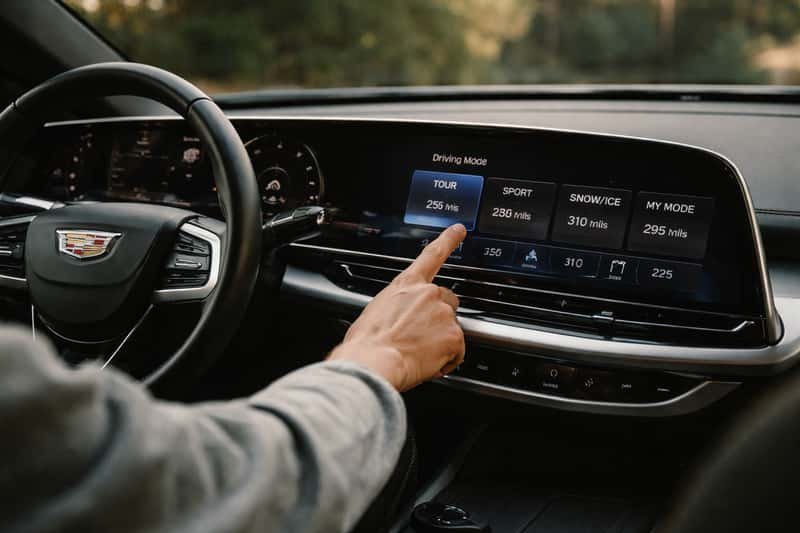
Now the mode people worry about. The Sport range loss runs roughly 10 to 20% in typical spirited use, with some owner reports on EV forums citing 15 to 25% under aggressive driving. On a 300-mile baseline, that is 30 to 60 miles gone per charge.
Here is the math, using the owner-reported 3.5 mi/kWh Tour estimate as the anchor. Take Tour at 3.5 mi/kWh across 102 kWh, call it 357 miles. Knock off 15% for Sport and you land near 303 miles. That 54-mile gap is a real charging stop on a long day. The U.S. Department of Energy’s breakdown of what drains an EV confirms the culprits: harder acceleration and higher speed burn disproportionately more energy.
But the label lies a little. Smooth, moderate driving in Sport can cost as little as 2 to 5%, while jackrabbit acceleration in Tour can lose just as much. The mode raises the ceiling. You decide how close to it you drive.
The Bullet Breakdown: Throttle, Regen, and Draw
- Throttle response: Sport maps the pedal for instant, aggressive power, which invites higher average draw even when you aren’t racing.
- Regenerative braking: Sport often prioritizes coasting feel over maximum energy recapture, quietly leaving miles on the table.
- Power draw: Higher sustained motor load means more kWh per mile, the single biggest driver of the 30 to 60 mile hit.
- Consequence: the penalty is behavior-linked, so a light foot in Sport can nearly match Tour.
Snow/Ice and My Mode: The Modes People Forget to Price
Two modes get skipped in most guides, and both carry a real number. Snow/Ice adjusts traction control and softens power delivery for low-grip surfaces. The Snow mode range penalty runs roughly 3 to 8% versus Tour per owner-reported data, because energy goes toward stability instead of pure efficiency. On 357 baseline miles, that is about 11 to 29 miles for the trade of not sliding into a ditch.
My Mode is the wild card. It lets you set acceleration, brake feel, steering weight, and motor sound. Its range impact swings from about 5 to 20% depending on how aggressive you make it. Configure it like Tour and you keep the miles. Configure it like Sport and you pay Sport prices.
Velocity Max on the Lyriq-V
The performance Lyriq-V adds Velocity Max, a mode built to trade efficiency for launch. Under spirited driving, owner reports and 2026 outlet coverage put the hit at 20 to 25% off range. On a 300-mile-class baseline, that is 60 to 75 miles surrendered for the fun. It is the clearest case of the pack draining faster while the battery size never changes.
One-Pedal Driving and Regen on Demand: The Bigger Lever
If you actually care about miles, this section matters more than which mode you pick. The one-pedal driving setup and the Regen on Demand paddle recapture kinetic energy back into the pack every time you slow down. Independent owner guides put the gain at 5 to 15% better range in city or mixed driving versus minimal regen.
Run the numbers against Sport. A 15% regen gain can erase most of Sport’s 10 to 20% penalty in stop-and-go traffic. That is why the strict “never use Sport” rule falls apart. A driver in Sport with strong one-pedal habits can out-range a driver in Tour who coasts everywhere and stabs the brake.
Regen is the lever with the most use. Set it aggressive, learn to modulate lift-off, and let the car pay you back on every deceleration.
Cost Per Mile, Annual Bill, and a Road Trip
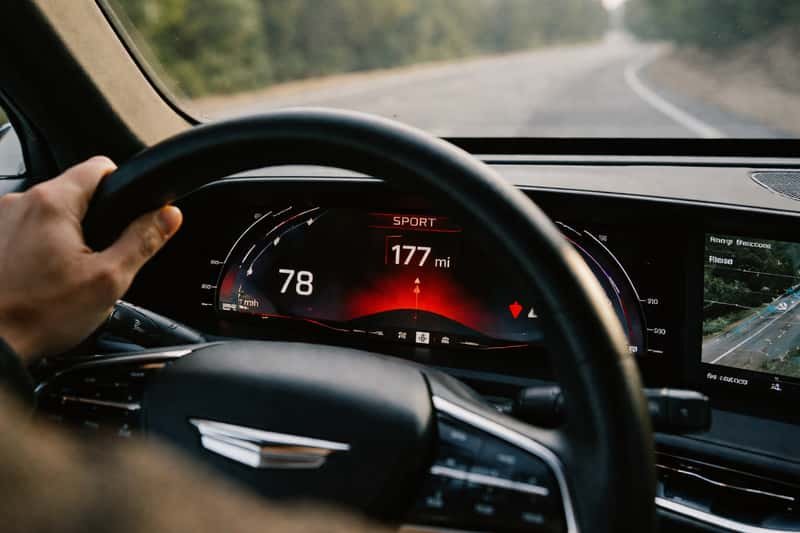
Turn efficiency into money. At a U.S. average of about $0.17 per kWh, cost per mile depends entirely on your miles per kWh. The efficiency figures below are owner-reported estimates from the InsideEVs and A Better Route Planner databases, not certified numbers.
| Mode | Efficiency (mi/kWh, owner-reported) | Cost per mile | 12,000-mi annual cost | Full-charge range |
|---|---|---|---|---|
| Tour | ~3.5 | $0.049 | $583 | ~357 mi |
| Sport (typical) | ~3.0 | $0.057 | $680 | ~306 mi |
| Snow/Ice | ~3.3 | $0.052 | $618 | ~337 mi |
| Velocity Max (V) | ~2.7 | $0.063 | $756 | ~275 mi |
The annual gap between Tour and typical Sport is about $97. Not ruinous, but real. Now the road trip. On a 400-mile drive, Tour at 357 miles of range needs one charging stop. Sport at 306 miles usually forces a second stop, adding 20 to 40 minutes and a few extra dollars. Drive Sport smoothly, though, and you might sneak by on one.
How HVAC, Heated Seats, and Aux Loads Stack On Top
Mode choice does not happen in a vacuum. Cabin heating can draw 3 to 5 kW in deep cold, heated seats add a few hundred watts, and both stack directly on top of whatever mode you selected. Run Sport with the heater blasting on a winter highway and the two penalties compound, easily pushing real-world loss past 30%. Heated seats are cheaper than heating the whole cabin, so they are the efficient way to stay warm without gutting your range.
Does Frequent Sport or Velocity Max Hurt Long-Term Battery Health
Higher-power modes generate more heat and higher discharge rates, which in theory add stress. The measured impact is small. A 2024 Recurrent Auto degradation study across roughly 15,000 EVs found modern packs lose about 1.8% capacity per year on average, and that GM’s liquid-cooled Ultium chemistry tracks with the best-performing packs in the sample. Recurrent and battery researcher studies consistently show that repeated DC fast charging and holding a pack at 100% state of charge in high heat drive far more degradation than aggressive discharge, which the thermal system manages by keeping the pack in its safe temperature window. Practically, occasional Sport or Velocity Max pulls add a rounding error to that 1.8% annual figure. Living at full charge in summer heat is the real accelerant.
The Nuances Most Guides Miss
The headline advice to avoid Sport is too blunt. Owner-data analyses show mode-induced swings are usually a few percent to 20%, while driving style, freeway speed, and cold weather swing range 10 to 30% or more. The mode is a small dial. Your habits are the big one.
How the Lyriq Stacks Up Against Tesla and Hyundai
Every modern EV does a version of this, and the numbers line up. Tesla’s Chill acceleration setting versus Standard shifts efficiency by roughly 3 to 7% in owner testing, with the bigger regen effect coming from its Hold braking mode. Hyundai’s Ioniq 5, which shares no platform with the Lyriq but competes directly, shows about a 5 to 12% efficiency spread between Eco and Sport per EPA and owner-reported figures, close to the Lyriq’s Tour-to-Sport gap. The percentages track because the physics is shared: harder throttle and weaker regen cost energy regardless of badge. What separates the Lyriq is the 102 kWh Ultium pack size and the granular My Mode customization, which give you more room to tune the drain than a one-slider rival.
Best Mode for Commuting, Highway, and Winter
For a stop-and-go commute, Tour with strong regen wins on both range and brake wear. On the highway, Tour still leads, since speed matters more than mode and Sport’s throttle map tempts heavier draw. In winter, Snow/Ice for grip plus heated seats over cabin heat is the efficient combo. For the best efficiency across the board, Tour with aggressive one-pedal is the default that keeps the most miles.
Odd Culture’s Read
The mode you pick sets a ceiling, but your right foot writes the actual number, and that gap is where most “Lyriq range” arguments go wrong. Yes, the modes change how fast the 102 kWh pack drains, no, they don’t move the EPA sticker, and a smooth driver in Sport can beat an aggressive one in Tour. Drive gently, lean on regen, and the mode debate mostly settles itself.
FAQs about do the driving modes in cadillac lyriq offer different ranges or battery usages?
Do Tour, Sport, and Snow/Ice modes change my range or just the feel?
Both. They change the feel of throttle and braking, and that shift in how you draw power changes real-world range by 20 to 70 miles per charge, even though the EPA rating stays fixed.
How much range do I lose driving my Lyriq in Sport all the time?
Typically 10 to 20%, or roughly 30 to 60 miles on a full charge. Drive Sport smoothly, though, and the penalty can shrink to just 2 to 5%.
Which driving mode gives the best efficiency in the Lyriq?
Tour delivers the closest thing to the full EPA range in normal driving. Pair it with strong regen or one-pedal driving for the best efficiency the car can offer.
Does My Mode affect battery usage or just comfort settings?
It affects both. My Mode adjusts acceleration and brake feel, so an aggressive configuration can cost 5 to 20% of range while a mild one behaves much like Tour.
Can regenerative braking really improve my Lyriq range?
Yes, meaningfully. Stronger regen and one-pedal driving can add 5 to 15% range in city or mixed conditions, often outweighing the difference between modes.
Do the driving modes change the Lyriq’s EPA-rated range?
No. The EPA range of about 308 to 326 miles comes from a fixed lab test cycle. Only your real-world results change with mode and driving style.
How much less efficient is Snow/Ice mode than Tour?
Roughly 3 to 8% less, because energy prioritizes stability and traction over efficiency. That is about 11 to 29 fewer miles, a fair trade for grip in bad weather.
What does each mode cost me per year in electricity?
At $0.17 per kWh and 12,000 miles, Tour runs about $583 a year, typical Sport about $680, and Velocity Max around $756. The Tour-to-Sport gap is roughly $97 annually.
Will frequent Sport or Velocity Max use hurt long-term battery health?
Not meaningfully. Recurrent’s degradation data shows modern packs lose about 1.8% capacity a year, and Ultium’s thermal management handles the extra heat from hard driving. Constant full charging and high heat age the pack far more than occasional performance pulls.
What’s the best mode for winter driving in the Lyriq?
Snow/Ice for traction, paired with heated seats instead of full cabin heat to save energy. Cold weather itself costs more range than the mode, so drive gently.